August 08, 2005
A Question of Numbers
Web: IranianVoice.org
August 08, 2003
Rouzegar-Now
Cyrus Kadivar
Rumours, exaggerated claims by the leaders of the Islamic revolution and a disinformation campaign against the fallen monarchy, not to mention Western media reports that the imperial regime was guilty of “mass murders”, has finally been challenged by a former researcher at the Martyrs Foundation (Bonyad Shahid). The findings by Emad al-Din Baghi, now a respected historian, has caused a stir in the Islamic republic for it boldly questions the true number of casualties suffered by the anti-Shah movement between 1963 and 1979.
In the aftermath of the fall of the Pahlavi dynasty in 1979, Ayatollah Khomeini, the leader of the Islamic revolution, ordered the creation of the Martyrs Foundation with the sole purpose of identifying the names of the so-called “martyrs” and provide financial support for their families as well as those who had sustained injuries in the fierce street battles with royalist troops. The necessary funds were immediately raised from the assets seized from the high officials in the Shah’s regime, many of whom had been executed after summary trials.
For many years the Martyrs Foundation collected the names of the victims of the anti-Shah revolution classifying them by age, sex, education, profession and address. The files were kept secret until 1996/7 when a decision was made to make public the figures on the anniversary of the revolution. At about this time, Emad al-Dib Baghi, was hired as a researcher and editor of the bonyad’s magazine “Yad Yaran” (Remembering our Comrades) to make sense of the data. By the time his work had finished he was told that the names were not to be made public. The reason given was that to pursue the matter would run contrary to the statements made by the late Ayatollah Khomeini and his successors who claimed that “60,000 men, women and children were martyred by the Shah’s regime.”
Emad al-Din Baghi who left the Martyrs Foundation to write two books on the subject claims that the authorities felt that releasing the true statistics would simply confuse the public. So, officials continued to stick to the exaggerated numbers. During a debate in the Majlis at the height of the US hostage crisis, an Islamic deputy claimed that giving in to America would be an insult to the memory of “70,000 martyrs and 100,000 wounded who fought to destroy the rotten monarchy.” In fact, by continuing the myth that so many people had been killed, the regime was able to buy a certain legitimacy for its “noble revolution” and excesses.
“Sooner or later the truth was bound to come out,” Baghi argued. In his opinion history should be based on objective findings and not baseless rumours which was the root of the anti-Shah hysteria and street demonstrations in 1978 and 1979. The true numbers are fascinating because contrary to the official view they are quite low and highly disproportionate to the hundreds of thousands murdered in the last 24 years in the Islamic republic.
The statistical breakdown of victims covering the period from 1963 to 1979 adds up to a figure of 3,164. Of this figure 2,781 were killed in nation wide disturbances in 1978/79 following clashes between demonstrators and the Shah’s army and security forces. Baghi has no reason to doubt these figures and believes that it is probably the most comprehensive number available with the possible exception of a few names that were not traced.
During the years separating the arrest of Khomeini on 5th June 1963 for instigating the riots against the Shah’s White Revolution and his return from exile on 1st February 1979, most of the 3,164 victims were in Tehran, Rey and Shemiran and 731 were killed in riots in the provinces which constitutes 14% of the country. Most of the casualties were in central Tehran and the poorer southern areas. Of this number 32 “martyrs” belong to the 1963 riots who were killed in 19 different parts of the Iranian capital. All were male and from southern Tehran.
Despite this revelation all officially sanctioned books in Iran dealing with the history of the Islamic revolution write of “15,000 dead and wounded”. Such wild figures have found its way in Western accounts.
Another myth is the number of those killed on Friday, 8th September 1978 in the infamous Jaleh Square massacre. On that day the Iranian government imposed martial law in Tehran after troops had fired at several thousand anti-government demonstrators in the capital. The opposition and Western journalists claimed that the massacre left between 95 and 3,000 dead, depending on widely varying estimates. Historians agree that the bloody incident was to be a crucial turning point in the revolution. Baghi refutes those numbers as “grossly inflated.”
The figures published by Baghi speaks of 64 killed among them two females – one woman and a young girl. On the same day in other parts of the capital a total of 24 people died in clashes with martial law forces among them one female. Therefore, according to Baghi, the number of people “martyred” on Black Friday is 88 of which 64 were gunned down in Jaleh Square. These statistics are closer to the figures announced by Dr Ameli Tehrani (executed by the revolutionaries) who served in Prime Minister Sharif Emami’s government. The Shah’s officials repeatedly spoke of 86 people dead and 205 wounded in clashes.
But at the time nobody in Iran was prepared to believe the government version, says Baghi, himself an ardent revolutionary in those troubled days. Instead rumours turned into facts and made headlines further weakening the Shah’s crumbling regime. Opposition leaders quoted figures as high as “tens of thousands” and agitators spread stories that soldiers had fired on the people from helicopters piloted by Israelis. Michel Focault, a leading French journalist, who covered the Jaleh Square wrote of “2,000 to 3,000 victims” and later increased the figures to “4,000 people killed” adding that the demonstrators had no fear of death.
The number of non-Muslims who died for the revolution was deemed by the Martyrs Foundation as “too insignificant” to be included in the list. Many of them were die-hard Marxist guerrillas who had fought running battles with the Shah’s secret police known as Savak. In the 1970s the Shah’s regime faced many threats from so-called Islamic-Marxist terrorists who carried out assassinations of top officials, kidnappings, bank thefts and bomb attacks on cinemas. Savak was given special powers to deal with this “terrorist” threat and appeared successfully ruthless in its “dirty war.” Savak’s crude brutality received a lot of criticism in the West. Amnesty International reported cases of illegal detention and torture.
But how many were killed? Baghi is methodical in the way he states numbers. Firstly, he claims that the total number of guerrillas killed between the 1971 Siahkal incident during which armed Marxists attacked a police station in a Caspian village and the February 1979 insurrection is 341.
The figure 341 is made up of 177 persons killed in shoot-outs with the Shah’s security forces; 91 were executed for “anti-state activities”; 42 died under torture; 15 were arrested and “disappeared”, 7 committed suicide rather than be captured, and 9 were shot while escaping. From among the guerrilla groups who died fighting the imperial regime the Marxist Fedayeen Khalq organisation suffered the highest losses. From the total figure of 341 killed, 172 were Fedayeens (50%); 73 Mujaheddin Khalq (21%); 38 fringe communists (11%); 30 Mujaheddin marxists before changing their ideology to Islamic (9%) and 28 Islamists (8%).
For completion sake, Baghi has added 5 other names to his long list. Four of them (Sadeq Amani, Reza Safar Herandi, Mohammad Bokharaie and Morteza Niknejad) were executed by firing squad after a military tribunal found them guilty of assassinating Prime Minister Mansour in 1965. The fifth name belonged to Reza Shams Abadi, a member of the Imperial Guard, who opened fire on the Shah as he came out of his limousine at the Marble Palace. The assassin was shot down by the king’s bodyguards. By adding these five names to the 341 we get the figure of 346 non-demonstrators killed between 1963 and 1979.
In addition to the 32 demonstrators killed in the June 1963 pro-Khomeini riots two other persons were shot dead in the following weeks in an undisclosed part of Tehran. On 2nd November 1963 a certain Mohammad Ismail Rezaie was murdered in jail and on the same day Haj Mohammad Reza Teyb was shot by firing squad at the Heshmatiyeh army barracks.
The mysterious death of the famous wrestler Gholam Reza Takhti in 1967 was attributed to Savak but Baghi has established that Takhti committed suicide. Unfortunately, Baghi makes no mention of the Islamic philosopher Ali Shariati and the Imam’s eldest son, Mustapha Khomeini. Both died of heart attacks in London and Najaf respectively. At the time of their deaths there were many rumours that they had been eliminated by Savak agents but subsequent evidence proves the opposite. Nevertheless, the negative effect on public opinion was tremendous and played a major role in eroding support for the Shah’s regime.
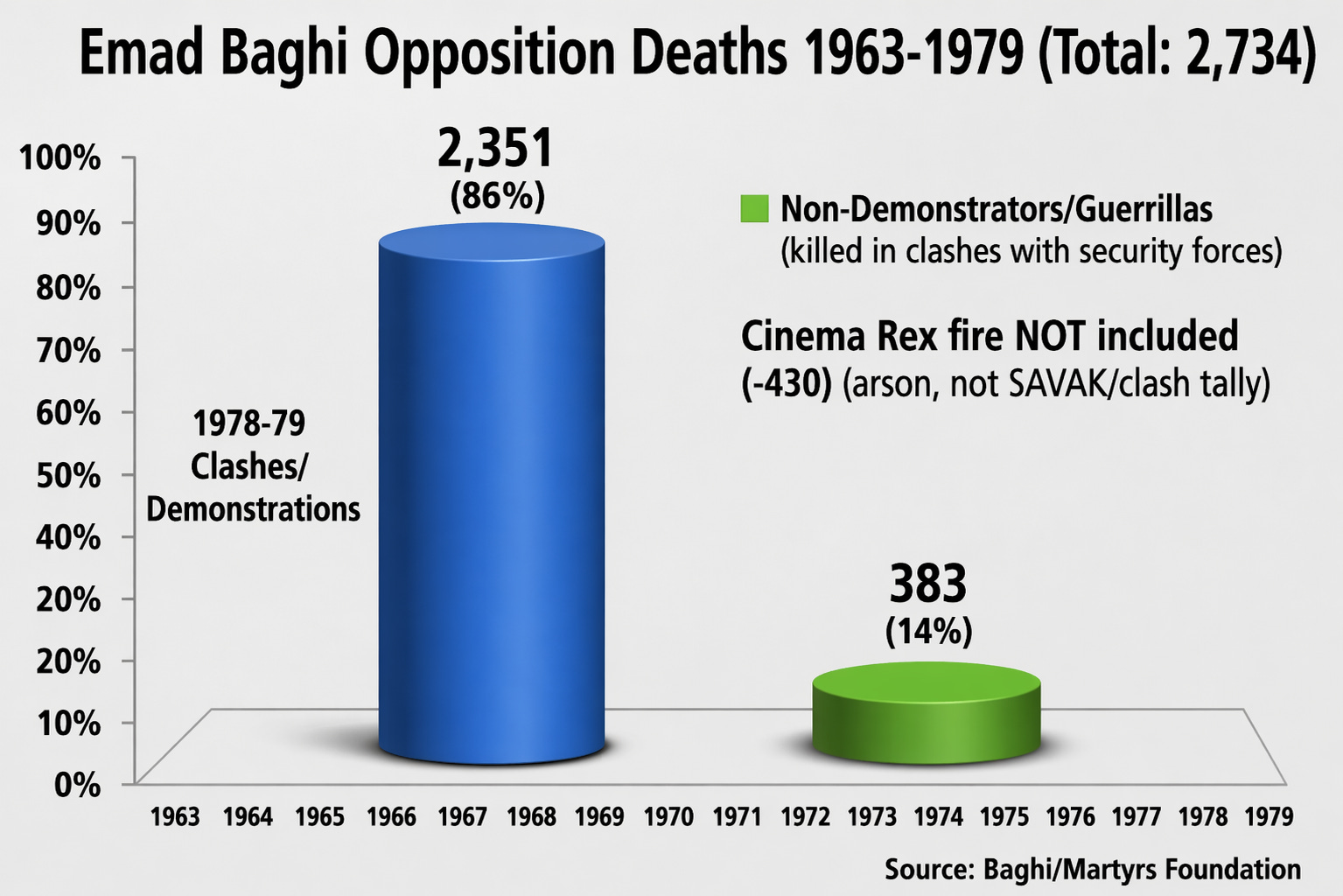
In any case, by adding Takhti’s name the total of those killed for underground action against the Shah’s regime comes to 383 which added to the 2,781 “martyrs” would mean that 3,164 Iranians lost their lives in the revolution against the monarchy and not 60,000 as the Imam had stated. In time, other historians may take up the task of finding the truth about the countless people executed or eliminated during the brutal 24 years rule of the mullahs. But that will only be possible in a free Iran and the findings may prove to be a greater shock.
Rouzegar-Now
August issue “
http://www.a-listonline.com/iran/html/article1056.html
The SAVAK Saga: How Exaggerated Propaganda Helped Topple the Shah
The SAVAK Saga: How Exaggerated Propaganda Helped Topple the Shah
Apr 15, 2026
Verification over slogans: What the documented numbers actually show
For decades, the story of SAVAK — Iran’s pre-1979 intelligence and security organization — has been told as a cartoon of unrelenting terror: an omnipotent torture machine that killed or imprisoned tens or hundreds of thousands. That narrative played a central role in the 1979 revolution. But serious research tells a more modest, contextual story.
Iranian journalist and human rights advocate Emadeddin Baghi (Emad Baghi) had unique access to the Islamic Republic’s own Martyrs Foundation records, police files, and SAVAK archives while initially tasked with documenting “martyrs” of the anti-Shah movement. His forensic audit, later published as A Question of Numbers, produced results that contradicted the revolutionary mythology.
Baghi found a total of 3,164 opposition-related deaths from 1963 to January 1979. Of these, 2,781 occurred during the chaotic final revolutionary clashes of 1978–1979. Guerrilla fighters killed in armed confrontations accounted for 341 deaths, with only 91 executions for anti-state activities and 42 deaths under interrogation. Political prisoners peaked at roughly 2,000–3,700 — far below the 100,000+ figures widely circulated at the time. Even the iconic “Black Friday” (September 8, 1978) saw 94 deaths according to Baghi’s verification, not the thousands claimed by opposition leaders.
The Real ContexT
SAVAK was not operating in a vacuum. It confronted a real and growing insurgency from a diverse array of armed Marxist and Islamist groups, many of which carried out bombings and assassinations targeting schools, buses, banks, theaters, and government officials. During the 1960s and 1970s, the Shah’s government faced a spectrum of militant opposition movements, including Marxist-Leninist guerrillas such as the Fedai and various Maoist factions, alongside Islamist and Islamist-Marxist organizations like the People’s Mojahedin.
These groups explicitly embraced armed struggle as a strategy, engaging in assassinations, urban guerrilla warfare, and attacks on both Iranian and foreign targets. In this context, SAVAK employed harsh interrogation methods against captured militants. Yet the scale and systematic nature of abuse were often dramatically exaggerated in exile narratives—particularly by figures such as Reza Baraheni, whose accounts were shaped by political affiliations, including ties to the Tudeh Communist Party.
Scholars provide essential perspective. In The Fall of Heaven, Andrew Scott Cooper draws directly on Baghi’s data and declassified records to show how the human rights narrative was weaponized, overshadowing the Shah’s not just modernization but nation building from scratch achievements in literacy, women’s rights, and infrastructure. Cooper’s earlier book The Oil Kings adds another layer: the Shah’s 1973 oil agreements challenged Western oil company monopolies, but a subsequent 1976 U.S.–Saudi deal contributed to Iran’s fiscal crisis and instability. James A. Bill’s The Eagle and the Lion further documents SAVAK’s role within Cold War realities while critiquing how U.S. policy and selective outrage helped erode the regime’s legitimacy.
In 1977–1978, facing mounting criticism, the Shah took the unprecedented step of inviting the International Committee of the Red Cross to inspect political prisons. The ICRC noted prior complaints of mistreatment in many facilities but observed improvements on follow-up visits, with no evidence of ongoing mass torture. These findings received far less attention than the lurid exile accounts.
Selective Outrage and the Carter Era
During the Carter administration, human rights rhetoric was weaponized deliberately to destabilize the shah’s government , with intense scrutiny directed at the Shah while comparable or more severe abuses elsewhere drew far less consistent global condemnation. In the United States, programs such as COINTELPRO subjected civil rights and political activists to systematic surveillance, infiltration, and coercive pressure, including figures like Martin Luther King Jr.. Episodes such as the Kent State shootings, along with documented abuses in police custody, underscored the willingness of state institutions to use force against domestic dissent.
At the same time, European powers faced far less sustained scrutiny for their own records. France’s conduct during the Algerian War involved widespread allegations of torture and repression, while United Kingdom maintained authority over numerous colonial territories well into the postwar era, often suppressing unrest through force. Yet these cases rarely generated the same level of sustained international pressure.
This pattern of selective outrage created a double standard that weakened the Shah at a critical moment, even as he released political prisoners and initiated reforms. It reflected not a universal application of human rights principles, but a geopolitical environment in which certain states were subjected to far greater scrutiny than others.
The Legacy — and a Striking 2026 Contrast
The exaggerated SAVAK narrative helped pave the way for the Islamic Republic, which quickly produced far higher death tolls — over 12,000 executions in its first four years alone — and reinstated harsher methods.
Even some critics of the current regime have acknowledged the embellishment. On January 22, 2026, analyst Karim Sadjadpour wrote:
“Iran’s Islamists came to power by significantly embellishing the Shah’s human rights abuses for Western NGOs and media. It’s now increasingly clear they’ve killed far more Iranians in recent weeks than were killed during the Shah’s entire four-decade reign.”
He linked a Bloomberg article reporting that deaths in the 2026 anti-regime protests could exceed 20,000 according to a UN special rapporteur, with one rights group verifying over 5,000 and reviewing nearly 10,000 more. The Bloomberg piece focused on current verification challenges but did not reassess history. The contrast with Baghi’s documented Shah-era total of 3,164 is stark.
Contemporary critiques have also pointed to the role of international advocacy organizations in shaping the narrative environment of the late 1970s. A Jerusalem Post analysis argues that left leaning Amnesty International’s reporting “played an important role in events leading up to the overthrow of Shah Mohammad Reza Pahlavi,” contributing to the erosion of his international legitimacy.
Amnesty International: Advocacy, Bias, and Accountability
The role of Amnesty International in shaping global narratives has long been influential, but it has also been the subject of sustained criticism. While Amnesty presents itself as a neutral human rights watchdog, a growing body of commentary and analysis argues that its reporting has, at times, reflected ideological bias, selective framing, and advocacy-driven conclusions rather than strictly neutral analysis.
This criticism is not limited to recent conflicts. A The Jerusalem Post analysis argues that Amnesty’s reporting in the late 1970s “played an important role in events leading up to the overthrow of Shah Mohammad Reza Pahlavi,” contributing to the erosion of his international legitimacy. Similar critiques, including those highlighted by CAMERA, have argued that Amnesty’s portrayal of the Shah’s security apparatus amplified allegations that were not always rigorously verified, helping shape a narrative environment with significant political consequences.
More broadly, watchdog organizations such as NGO Monitor have accused Amnesty of relying on selective sourcing and “misleading generalizations,” particularly in politically sensitive contexts. Debates within policy and academic circles over Amnesty’s use of legal frameworks—such as labeling certain conflicts with charged terms like “apartheid” or “genocide”—have further raised questions about whether advocacy objectives sometimes shape analytical conclusions.
These concerns intensified during the Gaza war, when Amnesty accused Israel of genocide, a claim that was strongly disputed and rejected by Israeli officials and widely debated among legal scholars and policymakers. The controversy was not only external. Amnesty’s own Israel branch publicly challenged the findings, leading to an internal institutional crisis and its subsequent suspension—an episode that underscored that concerns about methodology and bias are not confined to critics, but exist within the organization itself.
Taken together, these patterns point to a broader issue: when influential advocacy organizations shape global perception, errors, exaggerations, or selective framing can carry significant geopolitical consequences. Yet Amnesty International has not formally revisited or reassessed the role its reporting may have played in mischaracterizing the Shah’s Iran or contributing to the narrative environment that preceded the 1979 revolution. Nor has it issued a comprehensive institutional reflection on contested claims in more recent conflicts.
For observers concerned with historical accuracy, this raises a fundamental question of accountability. If human rights organizations demand transparency and responsibility from governments, should they not be held to the same standard when their own reporting proves incomplete, disputed, or politically consequential?
Why This Matters
No one needs to portray the Shah or SAVAK as saints. The agency operated in a dangerous era with real Marxist and Islamist insurgencies, and abuses did occur. But context and verification matter. Propaganda from Tudeh-linked circles and others was fed into Western discourse, often without rigorous checking, contributing to a revolution that delivered greater repression.
Iranians themselves have examined the records through Baghi’s work and archival access. Serious observers should do the same rather than recycle 1979 slogans.
Addendum:
/home/workdir/savak_myth_debunk_chart.png
Analysis of the article (Emad Baghi, “The Myth of SAVAK Mass Killings”):
The page presents a data-driven debunking based on the official archives of Iran’s Bonyad Shahid (Martyrs Foundation) — the very organization tasked with documenting “martyrs” of the anti-Shah struggle from 1963 to 1979. Baghi, who worked as a researcher there, reveals that the revolutionary narrative (promoted by Ayatollah Khomeini and later officials) wildly exaggerated SAVAK’s role in “mass killings.”
Key facts from the article:
- Total verified victims of the entire anti-Shah movement (1963–1979): exactly 3,164.
- Of these, 2,781 died in the 1978–1979 revolutionary disturbances — almost all from street clashes between demonstrators and the Shah’s army/security forces.
- Only 341 were guerrillas (mostly Marxist or Islamist militants) killed between the 1971 Siahkal incident and February 1979:
- 177 killed in shoot-outs
- 91 executed after trial
- 42 died under torture
- 15 “disappeared,” 7 suicides, 9 shot while escaping
- Black Friday (8 September 1978) — the most infamous alleged massacre: only 88 killed (64 in Jaleh Square, including two females; 24 elsewhere). This matches the Shah-era official count of ~86 dead. Revolutionary claims ranged from hundreds to 3,000–4,000.
- Earlier riots (1963): just 32 killed.
- Khomeini and others repeatedly claimed 60,000 martyrs; official books said 15,000 dead/wounded; a Majlis deputy claimed 70,000 martyrs + 100,000 wounded. All debunked by the regime’s own records.
SAVAK’s actual record: The agency did not engage in mass executions or indiscriminate slaughter. The vast majority of deaths occurred in open revolutionary clashes in the final months, not in secret police death squads. The “60,000 massacred by SAVAK” story was propaganda that helped justify the Islamic Republic’s far greater death toll (the article notes hundreds of thousands killed in its first 24 years alone).
The chart below visually captures this reality in one clear image: revolutionary hype versus documented facts. The myth collapses under the Martyrs Foundation’s own numbers.
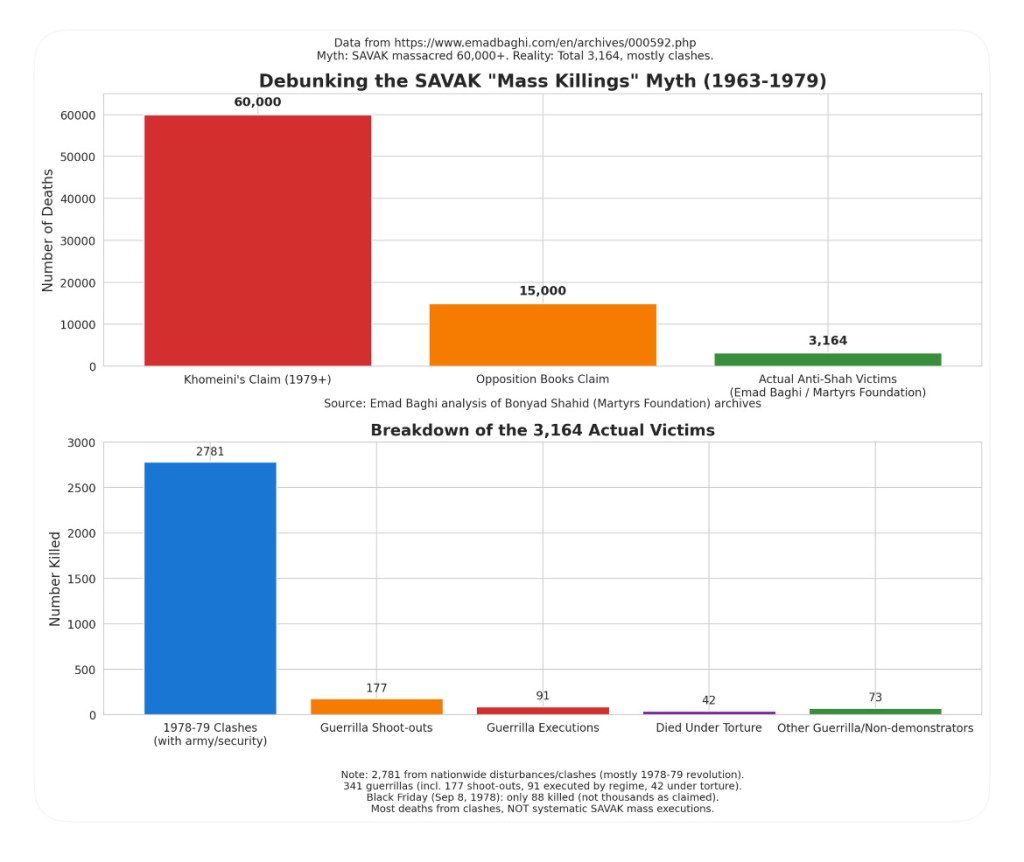
Key Sources:
- Baghi E. A question of numbers [Internet]. Emadbaghi.com; 2005 [cited 2026 Apr 15]. Available from: https://emadbaghi.com/a-question-of-numbers/
- Cooper AS. The fall of heaven:
- Bill JA. The eagle and the lion: the tragedy of American-Iranian relations. New Haven (CT): Yale University Press; 1988.
- Cooper AS. The oil kings: how the U.S., Iran, and Saudi Arabia changed the balance of power in the Middle East. New York: Simon & Schuster; 2011.
- Iran protest deaths seen rising with one estimate topping 20,000. Bloomberg [Internet]. 2026 Jan 22 [cited 2026 Apr 15]. Available from: https://www.bloomberg.com/news/articles/2026-01-22/iran-protest-deaths-seen-rising-with-one-estimate-topping-20-000
- International Committee of the Red Cross. Reports on visits to Iranian prisons, 1977–1978. Geneva: ICRC; 1980.
- Moghadam VM. Socialism or anti-imperialism? The left and revolution in Iran. New Left Review. 1987;(166):5–30. Available from: https://newleftreview.org/issues/i166/articles/val-moghadam-socialism-or-anti-imperialism-the-left-and-revolution-in-iran
- United States Department of State. Background note: Iran [Internet]. Washington (DC): U.S. Department of State; [cited 2026 Apr 15]. Available from: https://2001-2009.state.gov/r/pa/ei/bgn/5314.htm
- United States Senate. Final report of the Select Committee to Study Governmental Operations with Respect to Intelligence Activities (Church Committee) [Internet]. Washington (DC): U.S. Government Printing Office; 1976 [cited 2026 Apr 15]. Available from: https://www.intelligence.senate.gov/resources/intelligence-related-commissions/church-committee-reports
- United States Department of Justice. Investigation of the Ferguson Police Department [Internet]. Washington (DC): U.S. Department of Justice; 2015 [cited 2026 Apr 15]. Available from: https://www.justice.gov/sites/default/files/opa/press-releases/attachments/2015/03/04/ferguson_police_department_report.pdf
- Lewis J, Hensley T. The May 4 shootings at Kent State University: the search for historical accuracy. Ohio Council for the Social Studies Review. 1998;34(1):9–21.
- Evans M. Algeria: France’s undeclared war. Oxford: Oxford University Press; 2012.
- Elkins C. Imperial reckoning: the untold story of Britain’s Gulag in Kenya. New York: Henry Holt and Company; 20
- Segal Y. Amnesty International helped usher in Iran’s Islamic Revolution. The Jerusalem Post [Internet]. 2022 Mar 5 [cited 2026 Apr 15]. Available from: https://www.jpost.com/opinion/article-700409
- Committee for Accuracy in Middle East Reporting and Analysis (CAMERA). How Amnesty International helped usher in Iran’s revolution [Internet]. Boston (MA): CAMERA; [cited 2026 Apr 15]. Available from: https://www.camera.org/article/camera-op-ed-how-amnesty-international-helped-usher-in-irans-revolution/
- NGO Monitor. Amnesty International: profile and analysis [Internet]. Jerusalem: NGO Monitor; [cited 2026 Apr 15]. Available from: https://ngo-monitor.org/ngos/amnesty_international/
- Amnesty International and the apartheid claim against Israel. Berlin: Stiftung Wissenschaft und Politik (SWP); [cited 2026 Apr 15]. Available from: https://www.swp-berlin.org/publikation/amnesty-international-and-the-apartheid-claim-against-israel
- Amnesty report says Israel has committed genocide against Palestinians in Gaza. Reuters [Internet]. 2024 Dec 5 [cited 2026 Apr 15]. Available from: https://www.reuters.com/world/middle-east/amnesty-report-says-israel-has-committed-genocide-against-palestinians-gaza-2024-12-05/
- Council on Foreign Relations. Why Amnesty International suspended its Israel branch [Internet]. New York: CFR; [cited 2026 Apr 15]. Available from: https://www.cfr.org/articles/why-amnesty-international-suspended-its-israel-branch
SAVAK: The Cleanest Intelligence Agency in Modern History – A Defense Grounded in Evidence and Comparative Reality
Apr 16, 2026
A former young Islamic revolutionary—trained in Islamist Palestinian-Libyan camps, later a prominent professor in the Islamic Republic—says this. You can hear his younger self in English, and the older ZibaKalam in Farsi. I have the translation below.
Translation:
The Shah’s government did not carry out killings or massacres, despite what has been claimed before and after the revolution. I have shown this with facts, numbers, and statistics in my book, “The Shah Did Not Commit Massacres.” He could have certainly done so, but he did not order his army to carry it out.
I am convinced the revolution in 1979 was successful because his government did not commit killings. This has always made me wonder why.
The Shah had the ability to use force and suppress the uprising violently, but he chose not to order the army to carry out mass killings.
He argues that this restraint was one of the main reasons the 1979 revolution succeeded.
He then reflects on why the Shah acted this way. In his view, two factors played a role:
1.The Shah was terminally ill.
2.He did not trust the Americans and was suspicious of them, despite the commonly portrayed close relationship.
He concludes by describing the Shah as a very lonely figure at the end.
In the 1970s, Iran faced a severe national security threat from armed Marxist and early Islamist guerrilla groups, including the Fedaiyan-e Khalq and the Mujahedin-e Khalq (MEK). These organizations bombed banks, assassinated Iranian officials and Americans, attacked police stations, robbed banks, and waged urban guerrilla warfare. They operated with explicit foreign backing: primary Soviet ideological and material support for the Fedaiyan, PLO/Lebanese training camps used by both groups, Libyan aid under Gaddafi, and broader Arab revolutionary encouragement. These were not peaceful dissidents or mere critics but enemy combatants in a Cold War proxy subversion campaign aimed at destabilizing the Shah’s regime—a key Western ally.
SAVAK (Sazeman-e Ettela’at va Amniyat-e Keshvar), the National Intelligence and Security Organization established in the 1950s with CIA and Mossad assistance specifically to counter Soviet/Tudeh communist influence, was built for exactly this scenario. It treated armed, bomb-planting, assassinating militants not as domestic protesters but as hybrid threats of terrorism and espionage. The response was intelligence-first, targeted, and judicially constrained—no random purges, no foreign assassinations, no drug trafficking, no mass civilian dragnet—resulting in a documented record far cleaner than its peers or the far bloodier Islamic Republic that followed.
SAVAK’s Targeted, Intelligence-Led Response
SAVAK’s core mandate focused on surveillance and penetration. It ran informants inside universities, student circles, and guerrilla cells. Detection of foreign funding or arms links triggered full counterintelligence: wiretaps, mail intercepts, tailing, and turning low-level members.
In practice, this dismantled threats preemptively. For the MEK, SAVAK arrested the entire central committee—including co-founders—along with a large portion of cadres in 1971, before their full urban guerrilla campaign escalated. Similar operations targeted the Fedaiyan after their 1971 Siahkal insurrection.
Raids on confirmed armed cells (bomb-making, assassination plots, bank robberies) often involved shootouts. Foreign backing raised the stakes: these were proxies aiming to destabilize Iran. Historical outcomes from 1971–1977 included approximately 341 guerrillas killed in clashes or targeted operations, mostly Fedaiyan and MEK figures such as leader Hamid Ashraf (killed in a 1976 SAVAK ambush during a safe-house raid). There were no mass “disappearances”—just focused actions against active militants.
Captured suspects faced harsh but targeted interrogation to extract actionable intelligence on arms caches, safe houses, foreign handlers, and funding pipelines. Methods included bastinado (foot-beating), sleep deprivation, solitary confinement (including the so-called “coffin” tactic of extreme sensory deprivation in small enclosures), and worse—standard anti-guerrilla tactics of the era. Amnesty International documented allegations of such methods against political prisoners (primarily guerrillas). The goal was network disruption, not mass punishment.
Crucially, SAVAK itself executed no one. It handled arrest and interrogation; the judiciary conducted trials and sentencing, sometimes with UN representatives present. Serious cases involving assassinations or civilian-killing bombings led to executions after due process. Total political executions from 1971–1979 remained under 100 (broader estimates around 300 across the era, many tied to clashes). This was surgical action against armed actors—not purges of civilians or non-violent opposition politicians. Normal Iranians, journalists, and critical voices operated with relative freedom; SAVAK focused overwhelmingly on armed, foreign-linked insurgents.
Broader countermeasures addressed the foreign dimension: diplomatic pressure on backers and propaganda framing the groups as puppets acting “at the behest of their foreign patrons.” SAVAK stayed strictly domestic—no overseas assassinations, no black-budget operations—maintaining a clean profile on metrics where agencies like the CIA, KGB, Stasi, or post-1979 VEVAK/IRGC did not.
The popular Western and revolutionary narrative painted the Shah of Iran as a blood-soaked tyrant who murdered 100,000 political prisoners, tortured tens of thousands more, and stashed away $25–59 billion in Swiss banks while running a brutally repressive regime.
That narrative was completely false — and the proof came from the Islamic Republic itself.
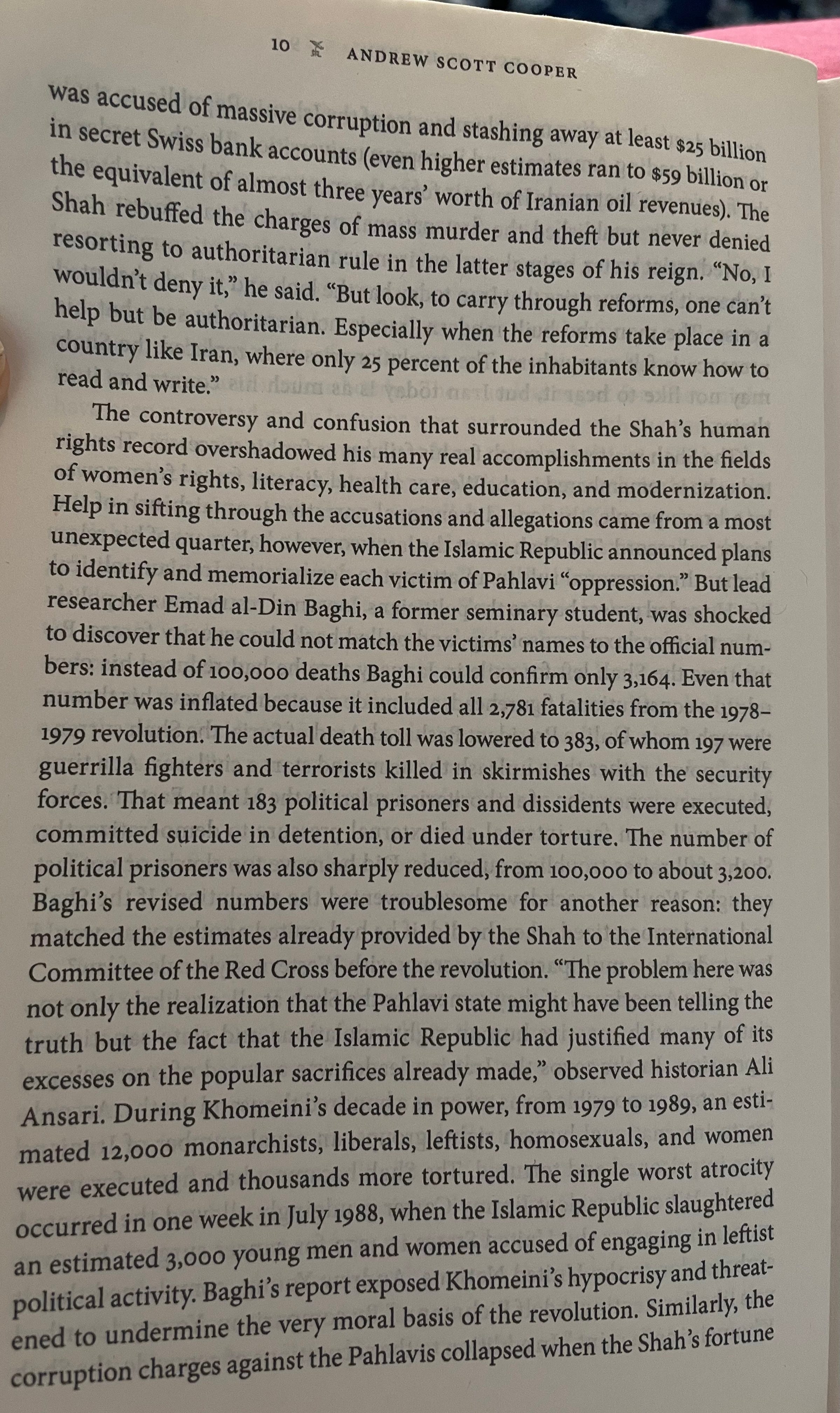
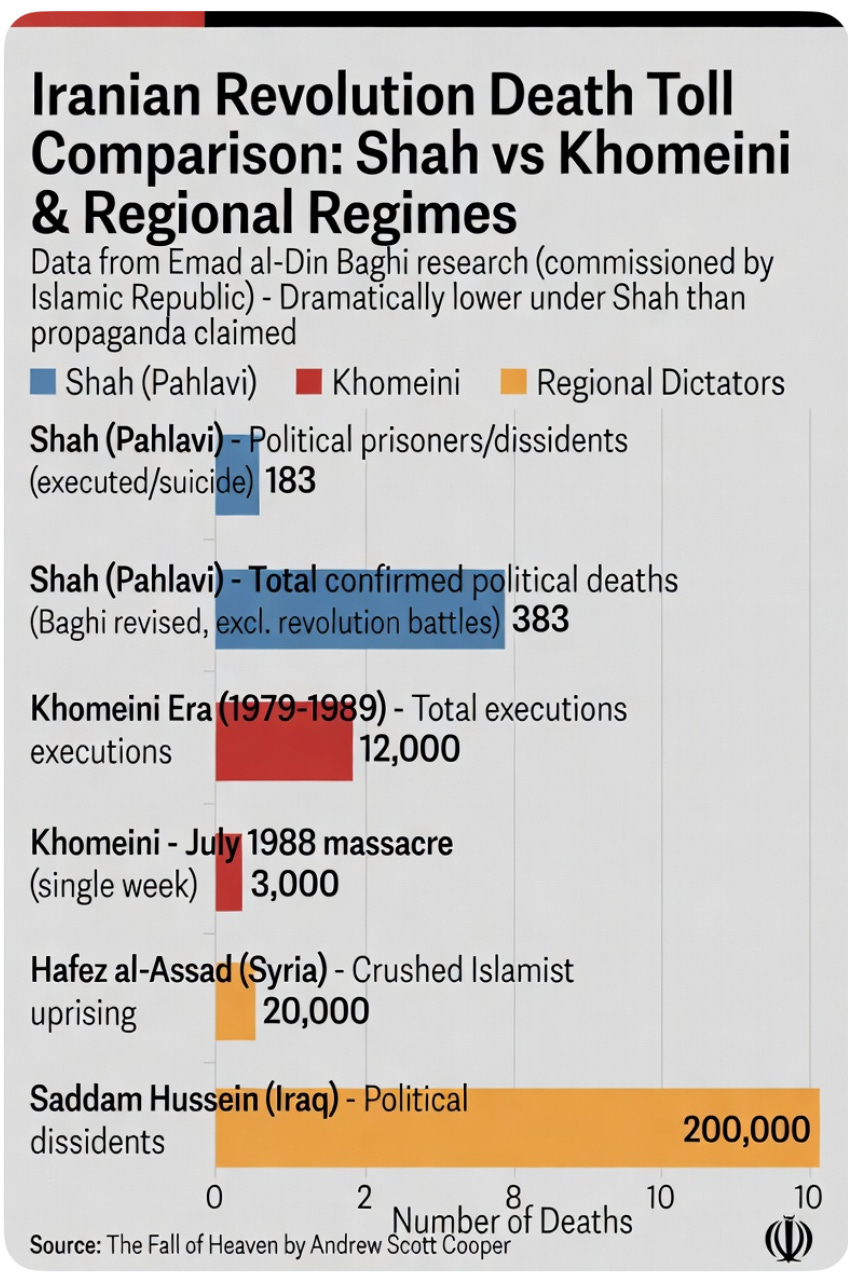
In the 1990s, the new regime decided to identify and memorialize every victim of “Pahlavi oppression.” Lead researcher Emad al-Din Baghi (a former seminary student) was shocked by what he found. Instead of 100,000 deaths, he could confirm only 3,164. Even that number was inflated: it included all 2,781 fatalities from the 1978–79 revolution. The actual death toll under the Shah for political prisoners and dissidents was just 383 — of whom 197 were guerrilla fighters and terrorists killed in armed skirmishes with security forces.
That leaves 183 people executed, who committed suicide in detention, or who died under torture. The claimed 100,000 political prisoners? Revised down to about 3,200.
Baghi’s numbers matched exactly what the Shah himself had reported to the International Committee of the Red Cross before the revolution. As historian Ali Ansari noted, this wasn’t just embarrassing for the Pahlavi state — it pulled the moral rug out from under the Islamic Republic, which had justified its own far worse crimes by claiming the Shah’s regime was uniquely monstrous.
Compare the actual record:
Under Khomeini (1979–1989): An estimated 12,000 monarchists, liberals, leftists, homosexuals, and women were executed, with thousands more tortured. The single worst atrocity was one week in July 1988 when the regime slaughtered ~3,000 young people accused of leftist activity — in just seven days.
The Shah’s fortune? Revealed to be well under $100 million — modest by royal standards and a tiny fraction of the $25–59 billion claimed.
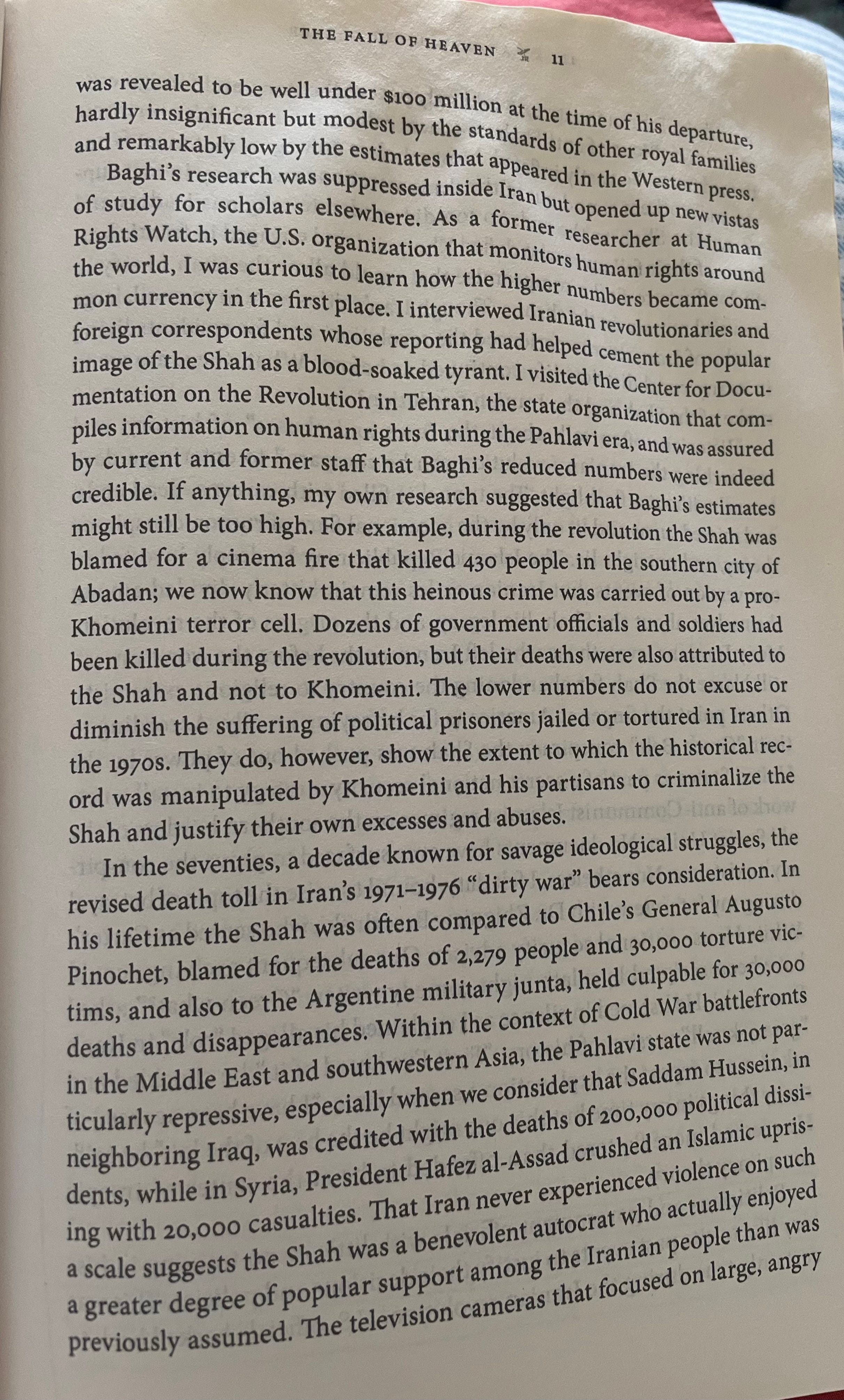
Even the infamous 1970s “dirty war” (1971–1976) death toll was dramatically lower than the propaganda suggested. The Shah was routinely compared to Pinochet (2,279 deaths) or the Argentine junta (30,000 deaths/disappearances). Yet in the same Cold War era, Saddam Hussein killed 200,000 political dissidents in neighboring Iraq, and Hafez al-Assad crushed an Islamist uprising in Syria with 20,000 casualties. Iran never saw violence on that scale.
The lower numbers don’t erase the real suffering of those imprisoned or tortured. But they prove the historical record was deliberately manipulated by Khomeini and his supporters to criminalize the Shah and justify their own excesses
As Andrew Scott Cooper (former Human Rights Watch researcher) documents in The Fall of Heaven, the Shah was a flawed who enjoyed far more genuine popular support than the revolution’s TV cameras — focused only on large, angry crowds — ever revealed. His real legacy in women’s rights, literacy, health care, education, and modernization was overshadowed by propaganda that the Islamic
emadbaghi.com/en/archives/00…
SAVAK Through the Eyes of Its Primary Adversary: The Soviets
A rarely cited but analytically powerful perspective comes from SAVAK’s principal Cold War adversary — the Soviet Union.
In a 1975 classified study published in the internal journal of the Higher School of the KGB, Colonel A. A. Gorokhov and Major General G. V. Pipiya assessed Iran’s intelligence apparatus based on KGB and GRU reporting. The Soviets portrayed Iran not as a peripheral backwater, but as a central Western intelligence hub aimed squarely at the USSR. SAVAK, they concluded, maintained close operational coordination with the CIA and Mossad, hosted multiple U.S. intelligence stations, and had over one hundred American intelligence personnel working out of Tehran and regional consulates.
From Moscow’s viewpoint, SAVAK’s mission was overwhelmingly external and strategic. The agency was actively running espionage against Soviet military, industrial, and nuclear sites — recruiting agents, infiltrating Soviet territory under civilian cover, and interrogating defectors for technical intelligence. The report also detailed a trilateral intelligence framework codenamed “TRIDENT,” linking SAVAK with Israeli and Turkish services for joint anti-Soviet operations across the region.
Equally revealing is what the KGB analysis does not emphasize. Written by a hostile service at the height of geopolitical rivalry, the study barely mentions domestic repression at all. Instead, it focuses almost exclusively on SAVAK’s professional capabilities, foreign intelligence successes, and effectiveness as a counterintelligence force.
This omission is telling. Even SAVAK’s primary adversary — with every incentive to amplify tales of Iranian brutality for propaganda or operational purposes — understood the agency first and foremost as a serious frontline player in the Cold War, not as a system defined by internal terror. This external focus aligns precisely with the empirical record you have already laid out: amid a genuine armed insurgency backed by Soviet and PLO networks, SAVAK’s own hands remained clean of executions, sentencing was left to the judiciary, and total political deaths stayed limited compared to the revolutionary bloodbath that followed.
Evidence Over Revolutionary Myth: Numbers and Fabricated Atrocities
The Islamic Republic’s own research confirms the restraint. Emad Baghi, commissioned by the regime’s Martyrs Foundation (Bonyad Shahid), documented just **3,164 total deaths** from 1963 to 1979—not the 60,000 enshrined in Khomeini’s narrative and the constitution. Of these, **2,781 occurred during the 1978–79 revolutionary street clashes** with security forces. The remainder (~383, including armed guerrillas killed in confrontations or after trials) exposes the “60,000 martyrs” figure as inflated propaganda. When Baghi’s lower numbers emerged, the regime suppressed them.
Specific horror stories that built SAVAK’s fearsome image were later exposed as fabrications or reframing, including the Cinema Rex fire (August 1978, 377–470 civilians burned alive), which was carried out by Shiite revolutionaries who confessed in court that they locked the doors and ignited the theater as “a step toward the revolution.”
The due process of Pahlavi-era trials has rarely been successfully contested, even in post-revolution European courts.
Harsh Interrogation Acknowledged – But Prisoners Themselves Draw a Stark Contrast
Former political prisoners, many of them leftists or guerrillas targeted for armed activities, have openly described SAVAK methods—including the “coffin” tactic of prolonged solitary confinement in small plywood or metal enclosures with sensory deprivation—as brutal during the interrogation phase. Yet the same survivors emphasize that Shah-era prisons were far more predictable and humane overall compared to the Islamic Republic’s system.
Naghi Hamidian (former Fedaiyan-e Khalq member) stated in a 2017 IranWire interview:
“You had flogging and torture and solitary confinement, but **after the trial, we only had to serve our sentences**. But under the Islamic Republic the prisoner is never safe until the day he is released. This was especially true in the 1980s. A detainee could be executed the day after his arrest. Every day that the cell door opened they might take the prisoner to the dungeons to torture or execute him. Under the Shah, solitary confinement and prison did not mean that they would kill us or retry us and issue a life sentence.”
He added that under the Islamic Republic, prisoners were treated as “extra baggage so they killed them off,” describing the early post-revolution regime as behaving “like a ‘Shia ISIS’” and concluding: “This, I believe, makes it impossible to compare the two periods.”
Monireh Baradaran (former leftist activist imprisoned under both regimes) experienced the “coffin” tactic under SAVAK, yet described Shah-era Evin as having a relatively tolerable communal atmosphere—“more like a boarding house than prison”—with opportunities for singing, reading, and social interaction. She explicitly stated there was **“no comparison”** to the systematic, unpredictable brutality she endured for nine years (1981–1990) under the Islamic Republic, where torture and the constant threat of execution were routine.
These accounts from an opposition-leaning outlet like IranWire reinforce that SAVAK’s harsh methods were targeted at dismantling armed networks during a dirty war, after which prisoners generally served fixed sentences without the arbitrary re-trials, mass executions (including the 1988 massacre), or total psychological destruction that defined the post-1979 era.
Comparative Reality: How the U.S. Handled Its Own Armed Marxist Resistance
When similar armed resistance—bombings, assassinations, and bank robberies—emerged in the United States during the 1970s (Weather Underground, Black Liberation Army, Symbionese Liberation Army), the American government responded with intelligence-led disruption: FBI infiltration, surveillance, raids, and federal prosecutions. Peaceful Marxist ideas remained protected speech, but violence triggered full suppression—mirroring SAVAK’s focus on armed actors while operating within stronger legal checks.
Quick Comparison
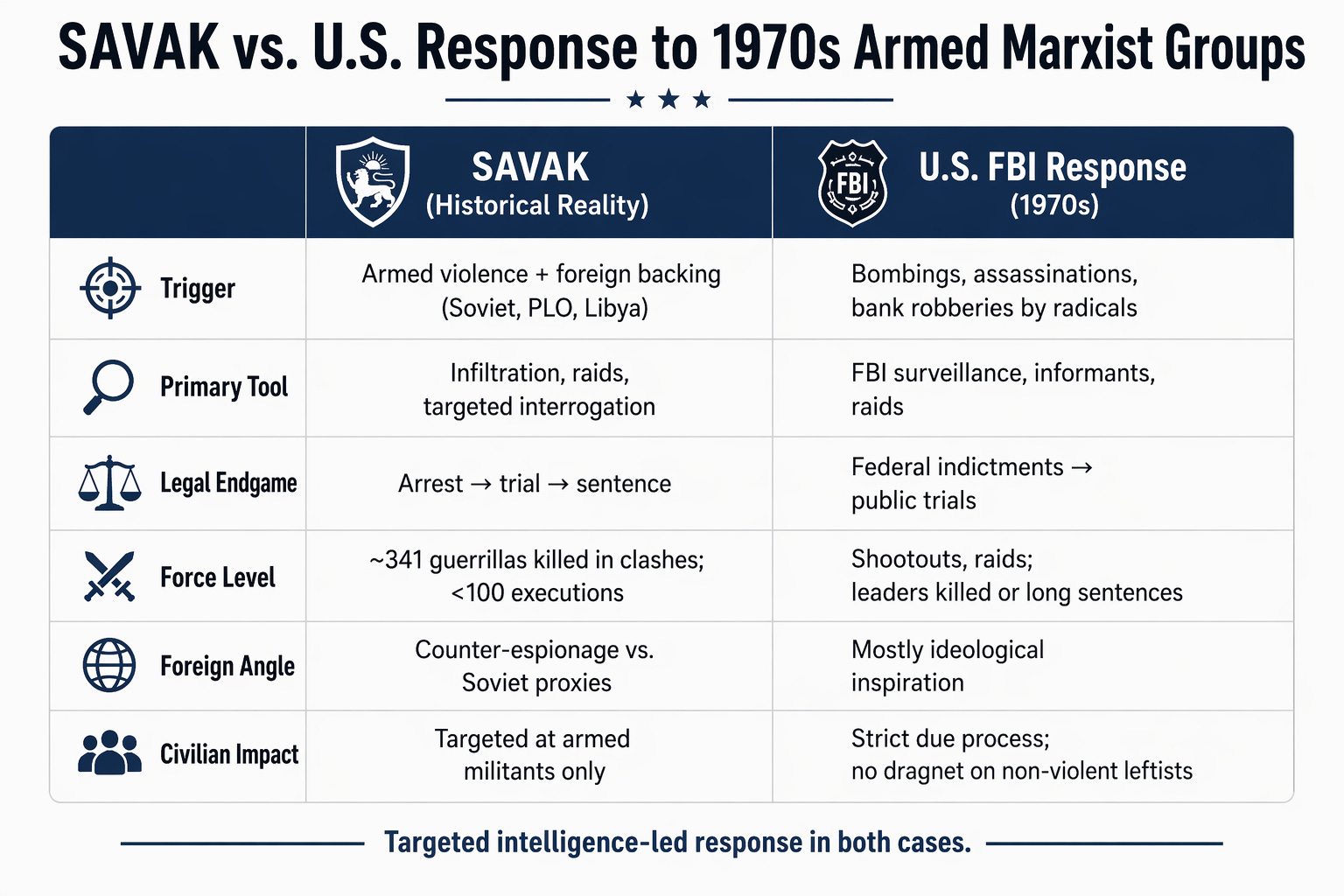
SAVAK earned its fearsome reputation among militants for effectiveness but remained the “cleanest” by documented outcomes: one main disputed custody incident (1975 Evin, 9 Fedaiyan in an alleged escape attempt), zero foreign assassinations or drugs, and a functioning legal system. It crushed the armed threat without fabricating martyrs or burning theaters itself. Foreign backing justified the intensity; without it, SAVAK barely touched non-violent critics.
The 1979 revolutionaries’ own suppressed Baghi data shows the “60,000 martyrs” claim were blatant and deliberate falsehood exaggerations. SAVAK was imperfect—torture occurred in a dirty war against foreign-funded violent armed militants Islamist and Marxist —but by scale, targeting, predictability after trial, and prisoner testimony, it was vastly superior to the mass killings, arbitrary executions, and unrelenting terror that followed under the Islamic Republic.
Truth over revolutionary myth: SAVAK defended Iran from foreign-orchestrated subversion with precision, not excess. The real tragedy was the chaos and far deadlier repression that replaced it. When armed resistance threatens a state—whether in 1970s Iran facing Soviet proxies or the U.S. facing Marxist bombers—the competent response is consistent: dismantle the networks, expose the backing, and let justice finish the job.
Videos above: both are the same person. Professor-terrorist Sadegh ZibaKalam
I also included a video with English subtitles. The third one from the top.
Young Islamist revolutionary (terrorist ) ZibaKalam and older Professor ZibaKalam:
A former young Islamic revolutionary—trained in Islamist Palestinian-Libyan camps, later a prominent professor in the Islamic Republic—says this. You can hear his younger self in English, and the older ZibaKalam in Farsi. I have the translation below.
Translation:
The Shah’s government did not carry out killings or massacres, despite what has been claimed before and after the revolution. I have shown this with facts, numbers, and statistics in my book, “The Shah Did Not Commit Massacres.” He could have certainly done so, but he did not order his army to carry it out.
I am convinced and it would have been impossibility to win the revolution without the shah’s restraint. The revolution in 1979 was successful because his government did not commit killings. This has always made me wonder why.
The Shah had the ability to use force and suppress the uprising violently, but he chose not to order the army to carry out mass killings.
He argues that this restraint was one of the main reasons the 1979 revolution succeeded.
He then reflects on why the Shah acted this way. In his view, two factors played a role:
1.The Shah was terminally ill.
2.He did not trust the Americans and was suspicious of them, despite the commonly portrayed close relationship.
He concludes by describing the Shah as a very lonely figure at the end.
References:
- Baghi E. A Question of Numbers [Internet]. emadbaghi.com; 2005. Available from: https://emadbaghi.com/a-question-of-numbers/
- Cooper, Andrew Scott: The Fall Of Heaven Amazon listing (preview + purchase):
https://www.amazon.com/Fall-Heaven-Pahlavis-Iran-1979/dp/0805098974 - Takbalizadeh H. Hossein Takb’alizadeh: One Person’s Story [Internet]. Iran Rights (Abdorrahman Boroumand Center). Available from: https://www.iranrights.org/memorial/story/-8094/hossein-takbalizadeh
- Cinema Rex fire [Internet]. Wikipedia. Available from: https://en.wikipedia.org/wiki/Cinema_Rex_fire
- McGhee B. Examining the Contradictory Nature of SAVAK and The Iranian Revolution [Internet]. California State University, San Bernardino ScholarWorks; 2023. Available from: https://scholarworks.lib.csusb.edu/cgi/viewcontent.cgi?article=1283&context=history-in-the-making
- FADĀʾIĀN-E ḴALQ [Internet]. Encyclopædia Iranica; 2015. Available from: https://www.iranicaonline.org/articles/fadaian-e-khalq/
- Weather Underground Bombings [Internet]. FBI History: Famous Cases. Available from: https://www.fbi.gov/history/famous-cases/weather-underground-bombings
- Black Liberation Army [Internet]. Wikipedia. Available from: https://en.wikipedia.org/wiki/Black_Liberation_Army
- . “The Shah’s Torture Made Us More Resolute” [Internet]. IranWire; 2017 Feb 21. Available from: https://iranwire.com/en/features/64435/
(Naghi Hamidian quotes on Shah-era vs. Islamic Republic prisons
- Torture Terrorizes Society at Large” [Internet]. IranWire; 2017 Mar 8. Available from: https://iranwire.com/en/features/64483/
(Monireh Baradaran on “coffin” tactic and comparison of eras.)
These survivor statements from IranWire, combined with Baghi’s suppressed research and the low documented toll, provide powerful firsthand evidence that SAVAK’s record—though harsh toward armed insurgents—was nothing like the systematic nightmare that followed 1979.
11. KGB Higher School Journal. Papers of the Higher School of the KGB. Article by Gorokhov AA, Pipiya GV on Iranian intelligence services; 1975. Summary available from:
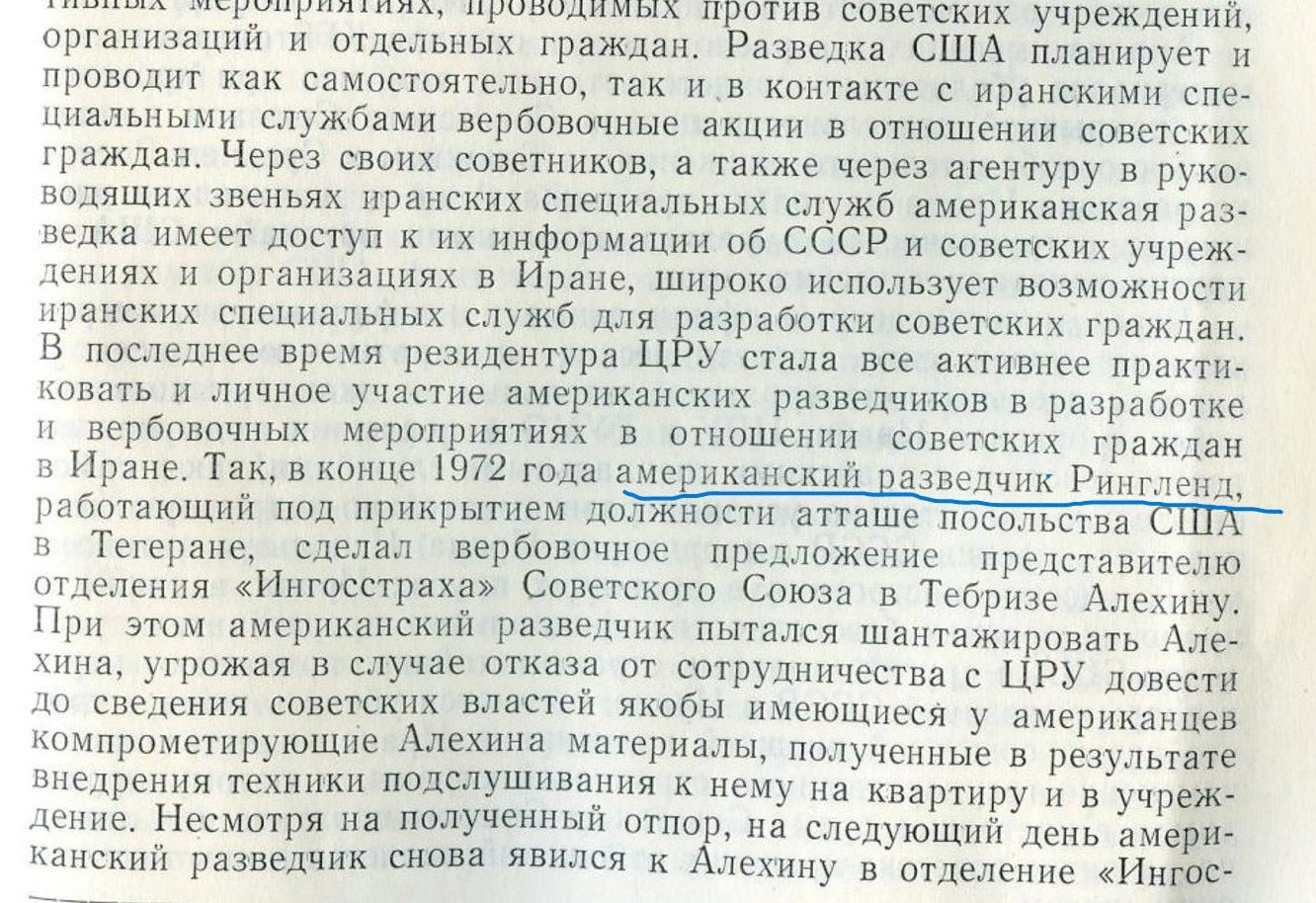
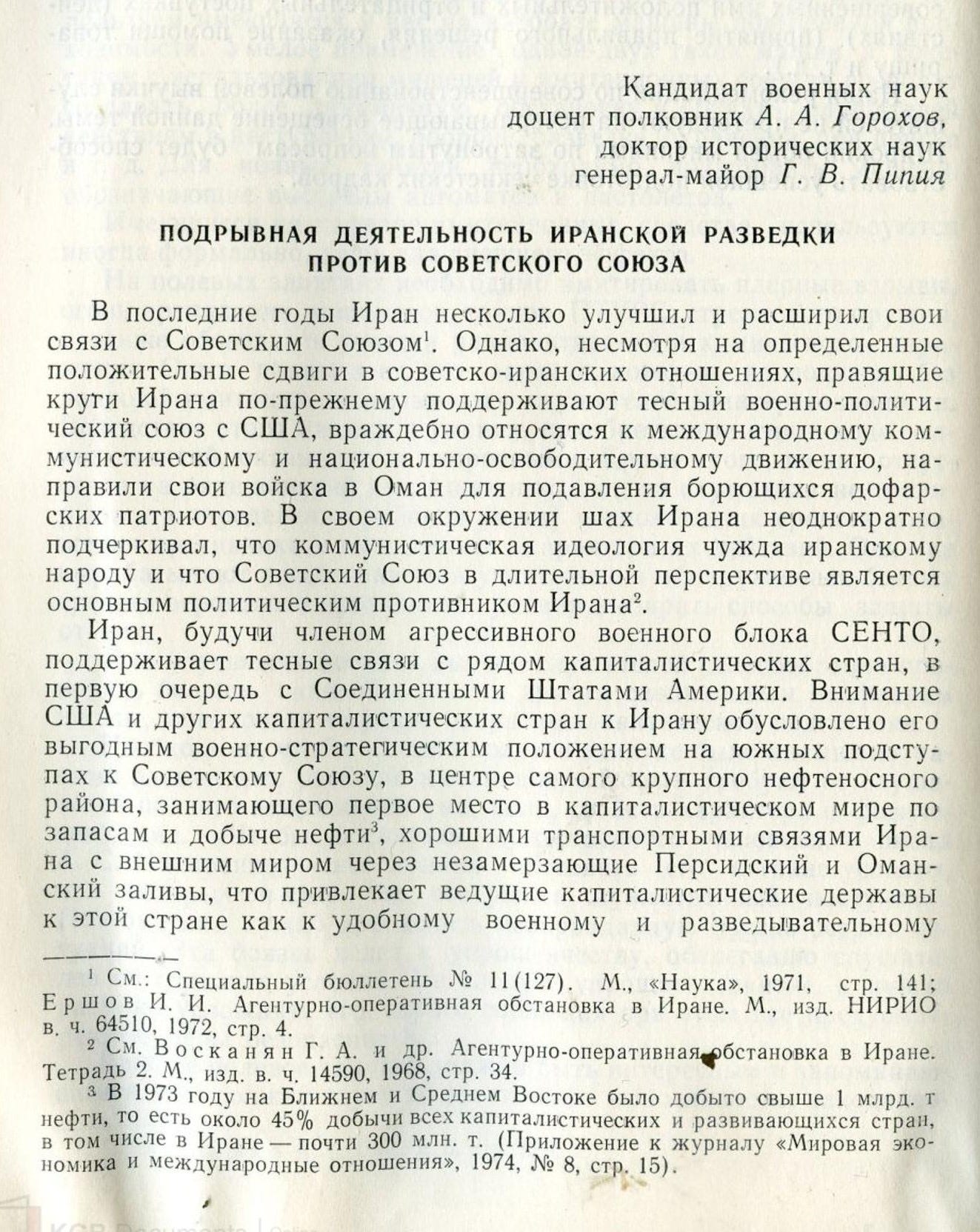
What KGB Knew About Iran’s SAVAK & CIA in Iran in Mid-1970s
9 months ago · 10 likes · 1 comment · KGB Stuff by Filip Kovacevic
https://kgbstack.substack.com/p/what-kgb-knew-about-irans-savak-and
—————————————————————————————————————————————————-
https://x.com/aliemamiofnyc/status/2044792104333799818

I keep repeating this till the most brainwashed of them get it. even the far-most-idiots at EU Parliament!
SAVAK was the CLEANEST Intelligence Agency in the modern history of states!
1- SAVAK is the ONLY secret service agency that unlike its counterparts (CIA, MI6, Mossad, KGB, Stasi, VEVAK) that has ZERO documented record of: – foreign assassinations – drug trafficking – financial black holes – making people disappear – civilian targetting – political purges
2- The only disputed death-in-custody event in the ENTIRE history of the agency is 9 Fedaiyan (Soviet-backed ARMED insurgent group) prisoners at Evin in 1975. SAVAK claims it was a prison escape attempt, revolutionaries claim they were shot. Until freedom of information in Iran, there is no public access to the files. But even accepting the revolutionary version, one incident in 22 years of agency history is negligible
3- SAVAK only dealt with armed communist terrorists, not regular people. Groups like Fedaiyan-e Khalq and MEK bombed banks, assassinated Iranians and American, attacked police stations, kidnapped people, and operated with Soviet backing. These were not peaceful dissidents. They were armed insurgents working for a hostile foreign power.
4- SAVAK did not execute ANYONE. It was an intelligence agency. Its job was surveillance, gathering information, and arresting suspects. The judiciary conducted trials, sometimes with UN representatives present, as in the Golsorkhi case. That is a functioning legal system, not a killing machine. the due process of those trials HAVE NEVER been successfully contested, even after collapse and even in european trials.
5- Normal Iranians did not have to deal with SAVAK. Journalists critical of the Shah operated freely. Politicians in opposition existed. The agency only targeted armed groups backed by hostile foreign powers. Others were contacted and questioned but NEVER pressed or prosecuted. some of the stories that built SAVAK’s fearsome reputation:
6- Reza Baraheni claimed he was hung by his testicles while a bear attacked him. This was accepted during revolutionary fervor but later became satire because of how ridiculous it was. His own friend Hassan Roozpeykar, also a SAVAK prisoner, told him his experience was nothing like what Baraheni described. Baraheni admitted he “did what he needed to help the cause. His book “Crowned Cannibals” has been recognized to contain gross fabrications, claiming 300,000 people were imprisoned and 5,000 kidnapped in one day using tanks. He published his torture claims in Penthouse magazine.
7- Daryoush Eghbali, the famous singer, claimed he was in SAVAK custody for revolutionary songs. It was later revealed he was in police custody on heroin charges. This is public knowledge. Daryoush himself has been open about his struggle with heroin addiction.
8- Gholamreza Takhti, Iran’s beloved Olympic wrestler, was found dead in 1968. Opposition claimed SAVAK murdered him. His own son Babak Takhti has confirmed his father took his own life. Takhti suffered from depression and marital problems. Revolutionaries and Islamic Republic maintains the murder narrative of admiration as a martyr.
9- Samad Behrangi, author of “The Little Black Fish,” drowned in 1968. Blamed on SAVAK. Hamzeh Farahati, the army officer WHO WAS WITH HIM when it happened, confirmed to VOA and BBC Persian it was a common drowning. He stated that “revolutionaries’ allegations of governmental involvement originated from their need to fabricate a martyr.”
10- Cinema Rex fire, August 1978. Between 377-470 people burned alive. Revolutionaries blamed SAVAK. It has been long cleared that four Shiite revolutionaries locked the doors and set the theater on fire. One of the arsonists, Hossein Takbalizadeh, confessed in court: “I believed that this act was a step towards the revolution.” In 2001, Iranian newspaper Sobhe Emrooz revealed the truth and was immediately shut down by the Islamic government. The revolutionaries burned 470 people alive, blamed the Shah, used it to fuel their revolution, then silenced anyone who told the truth.
11a- Ahmad-Reza Gholami, a Fedaiyan-linked militant in the early 1970s, was severely injured when a homemade firebomb detonated while he was assembling it for an attack. The explosion destroyed part of his face and left him permanently disfigured. He later reframed those injuries as “SAVAK torture,” blaming the security services for wounds that occurred during bomb preparation. 11b- Bahram Aram, a senior MEK military commander, was killed in 1976 when he detonated a grenade himself to avoid capture by security forces during an armed confrontation. His death occurred in active militant operations, not in custody. Yet after 1979, Aram was routinely presented in revolutionary narratives as a “victim of SAVAK torture,” blurring the line between armed combat deaths and custody abuse to expand the mythology of secret-police brutality. There are countless other cases like these. Now the numbers:
12- After the revolution, the Islamic Republic hired revolutionary Emad al-Din Baghi to document victims of the Shah. Khomeini claimed 60,000 martyrs. This number is in the Islamic Republic’s constitution. Baghi could only confirm 3,164 deaths over 16 years (1963-1979). Of those, 2,700 were during the revolution itself in street clashes, not SAVAK. Over 450 were Cinema Rex victims, which revolutionaries caused. When Baghi tried to publish his findings, the regime told him to bury it. The Martyrs Foundation (Bonyad Shahid) confirms these numbers.
13- The Red Cross (ICRC) investigated SAVAK and found far lower incidence of torture and fewer political prisoners than claimed. Their findings were ignored by the same media that had condemned the Shah. Amnesty International had to change its policy after repeatedly pursuing cases only to discover the prisoners had already been released. Now let’s compare SAVAK to other agencies:
14- CIA: COINTELPRO assassinations, MKUltra experiments on citizens, Phoenix Program (20,000+ Vietnamese killed), drug trafficking (Iran-Contra, Afghanistan), black site torture programs worldwide.
15- KGB/FSB: Millions killed in Gulag system, systematic torture, assassinations abroad (Litvinenko, Navalny), total surveillance state.
16- MSS China: 1+ million Uyghurs in concentration camps, systematic torture documented by UN, runs its own detention facilities where people disappear.
17- RAW India: 5,591 people shot by police between 2017-2023 alone, legal immunity for security forces, extrajudicial killings in Kashmir, assassination plots in Canada and US. 18- Stasi East Germany: 1 in 6 citizens were informants, systematic psychological torture, total surveillance of population.
19- VEVAK/IRGC Islamic Republic: 1988 massacre (3,000-30,000 executed in weeks), chain murders of intellectuals, 2019 protests (1,500 killed), 2022 protests (500+ killed), 63+ foreign assassinations documented. over 30,000 in the january uprising and SAVAK???? 9!!!!!!
The ONLY major intelligence agency that never ran drugs, never made people disappear, never targeted civilians, never targeted political rivals, and actually used a functioning legal system.
Yet SAVAK is demonized and the lefties love Islamic Republic. #IranMassacre #SAVAK #Revolutionlran2026 #جاوید_شاه

·

