Why Western Skeptics Still Doubt the Shah’s Popularity in Iran: The Media Blackout on Raw Street Truth
Apr 18, 2026
For months, ordinary Iranians — young people, families on balconies, students, and workers — have risked bullets, arrest, torture, and the regime’s savage internet blackouts to record and smuggle out videos from the streets and rooftops of Tehran, Isfahan, Karaj, and beyond.
Their chants are clear, rhythmic, and growing louder:
“Ey Shah-e khooban, bargard be Iran!
Amamehdaran ridand too Iran!”
(“O Shah of the good ones, come back to Iran! The turban-wearers have shat all over Iran!”)
“Javid Shah!” — Long live the Shah.
“This is the final battle — Pahlavi will return.”
These are not diaspora productions or edited nostalgia clips. They are raw footage of crowds marching at night, residents chanting from windows during blackouts, and protesters facing live fire while calling for the Pahlavi path after 47 years of the alternative.
Here is just a sample of what Iranians inside the country have sent out:
– Tehran nighttime street march (January 9, 2026): Thousands marching shoulder-to-shoulder under streetlights, chanting “Ey Shah-e khooban, bargard be Iran!” — the exact video we discussed:
https://x.com/Vahid/status/2009721234968457513
3:17 PM · Jan 9, 2026 · 224K Views
162 Replies · 2.47K Reposts · 10.6K Likes
– Tehran workers’ quarters — “Javid Shah” as regime bikes burn (January 8, 2026):
– Tehran balcony and rooftop chants defying the blackout (January 9, 2026):
and
– Yousef Abad neighborhood, central Tehran — large crowd chanting “Javid Shah” and “Down with the Dictator” (January 8, 2026):
– Tehran — “Javid Shah” echoing rapidly across multiple neighborhoods (late December 2025–January 2026):
– Karaj (near Tehran) — “Long live the Shah” moments after an explosion (March 13, 2026):
(Also shared via NUFDIran on Facebook: https://www.facebook.com/NUFDIran/posts/iranians-chant-long-live-the-shah-king-moments-after-an-explosionkaraj-alborz-pr/955907976808795/)
– Homayounshahr (Khomeinishahr), Isfahan Province — “Long live the Shah” while honoring murdered protesters (February 20, 2026):
– Tehran — protesters with drums chanting “Long live the Shah” (January 8, 2026):
– Ekbatan neighborhood, Tehran — residents chanting “Long live the King” (March 2026 context):
(
These videos show determined faces, winter jackets, city streets lit by streetlights or fires, Persian signs, and ordinary Iranians refusing to stay silent even as the regime cuts connectivity and fires on crowds.
Yet if you get your news primarily from Western mainstream outlets, you might hear little or nothing about this surge — or see it quickly caveated as “unclear how widespread,” “economically driven,” “a loud minority,” or framed through the tired 1979 lens of “neither Shah nor clergy.”
That skepticism persists precisely because much of this raw, unfiltered street truth never receives sustained coverage. The regime’s blackouts help: when footage leaks via Starlink or smuggled phones, it’s easier for skeptics to dismiss it than to grapple with what it means.
Iranians have lived both systems with their own eyes and scars. They have reexamined the decades of propaganda against Mohammad Reza Shah — the “puppet of the West,” the SAVAK police-state myth, the exaggerated extravagance tales, and the lie that pre-1979 Iran was a developmental failure. In my earlier article, I laid out the primary sources and data showing a rapidly modernizing nation with rising literacy, women’s rights, infrastructure, and regional pride — a future stolen in 1979.
Read my article. It explains how Iranians Have Reexamined the Propaganda Against the Shah — Westerners Haven’t.
https://gorbehkay.substack.com/publish/posts/detail/194421010
Now the Iranian people are delivering their verdict in real time, at enormous personal cost. After nearly five decades of clerical rule — economic collapse, moral policing, mass executions, exported terrorism, and turning Iran into a pariah state — many are openly chanting for the Pahlavi path back. Not necessarily as blind restoration, but as a rejection of everything the mullahs have done and a call for the chance to choose in a free referendum (exactly what Reza Pahlavi has long advocated).
This is profoundly uncomfortable for parts of the Western commentariat. It shatters the comforting narrative that the 1979 revolution was a legitimate popular uprising against a cartoon “brutal dictator.” It forces a reckoning with how catastrophically that experiment failed the very people it claimed to liberate. And it challenges reflexive suspicion of pre-revolutionary Iran or any modernization associated with the West.
So the videos — the nighttime marches in Tehran, the balcony chants echoing through neighborhoods, the students and workers risking everything — are often ignored, downplayed, or not amplified. Meanwhile, Iranians continue to correct the history books with their voices and courage.
The chants you hear in these clips are not nostalgia. They are judgment.
Western skeptics who still doubt the reclaimed popularity of the Shah aren’t operating from superior information. They’re often refusing to engage with the information that is there — the unfiltered recordings that the regime desperately tries to bury under blackouts and violence.
If Western media and analysts truly want to understand Iran in 2026, they must stop filtering everything through outdated 1979 lenses. They need to watch what Iranians are actually saying when the cameras roll in the dark, under threat of live ammunition.
The volume is high. The blackout cannot hide it forever.
The Iranian people have reexamined the old propaganda — loudly, bravely, and at great risk.
The question is why so many in the West still refuse to do the same.
Watch more of the evidence directly from the streets:
– More Tehran “Javid Shah” during protests:
– Jerusalem Post coverage with footage references: https://www.jpost.com/middle-east/iran-news/article-882714
What happens when a nation looks at 47 years of “revolution” and decides the old king wasn’t the problem — the mullahs were?
The answer is echoing across Iran , in videos the world can still see if it chooses to look.
more videos from the recent pro Pahlavi uprising:
4:23 PM · Apr 18, 2026 · 627 Views
6 Replies · 18 Reposts · 70 LikesConstance@Constan63413921Exactly 100 days ago, at these very same hours, Jalil Milanlouei recorded this video two hours before heading to the streets on January 8, 2026 and went out to fight for the freedom of his homeland. This post refers to the final video recorded by Jalil Milanlouei (aحشاشین @Hashshaashin100 روز پیش، دقیقا در همین ساعات، جاویدنام جلیل میلانلویی دو ساعت قبل از رفتن به خیابان در 18 دی، این ویدئو را ضبط کرد و رفت تا برای آزادی میهنش بجنگد. #جاویدشاه5:15 PM · Apr 18, 2026 · 8 Views1 Like
A rare video of the late Shah recounting an assassination attempt he survived, February 4, 1949. A man disguised as a photographer shot 5 times at point blank range.
Thanks to Afshine Amrani for posting this video.
Mohammad Reza Pahlavi (1919-1980)
Jul 27, 2005
Darius Ryan, Switzerland – Persian Journal
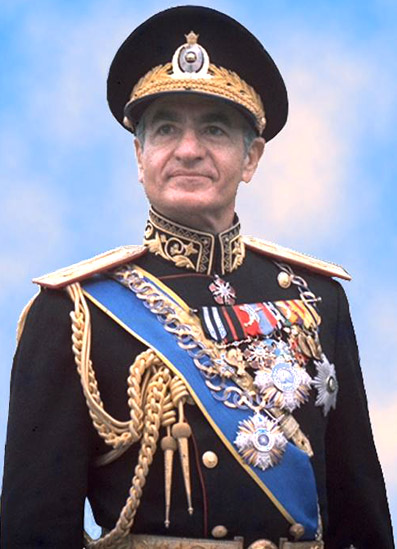
To understand the truth about the late shah
and what really happened in Iran in 1979,
one must read this article by Alan Peters,
An expert on security and intelligence matters in Iran.
=================================
Mohammad Reza Pahlavi (1919-1980),
A retrospective on his reign on the occasion of the twenty-fifth anniversary of his death.
“They revere you in fortune
and trample you in defeat”
(Moliere)
Some 25-years ago this summer, Mohammad Reza Pahlavi the Shah of Iran was dying in Cairo. Egypt’s President Sadat had offered him his last refuge and helped him escape from a perilous exile in Panama.
Historically, Egypt has been famous for providing shelter – even to those they do not approve – like the family of Yasser Arafart – at the time that Arafat was public enemy #1 in Egypt for inciting the overthrow of Sadat’s regime, his wife and children were guarded by Sadat’s government bodyguards.
In the case of the Shah, Sadat liked him and the Shah’s marriage to former Egyptian King Farouk’s sister made him “family”, too.
In Panama, the fate of the ailing monarch had hung in the balance for several weeks as shadowy contacts between Panama’s strongman, General Torrijos, and emissaries from the Islamic revolution increasingly pointed to a swap deal – the extradition of the Shah against the release the 52 American Embassy hostages in Tehran.
While the Shah’s hand-over to Khomeini was seriously contemplated by President Carter, his administration had been drawn into an eerie gambit in Panama of which the hostage end-game was unknown .
The Shah’s succumbing to cancer on July 27th, 1980 must have brought a sigh of relief in Washington as indeed in many other capitals burdened by the past courtship for refuge of the Iranian monarch, many of whom had previously benefited from his largesses.
Two decades and many sorry events later, some of the intricacies of the Shah’s personality and rule still beg scholarly probe.
The majority of Iran’s current population has been born after the Shah’s demise. His image in their mind, as indeed in the minds of many casual observers abroad, has been shaped through unrelenting distortions of historical facts by Carter and an obliging liberal Media, intent on justifying Carter’s decision to remove the Shah.
The younger Iranians deserve an unbiased account of these 37 years in its baffling turns and twists and contradictions. Including that when he left Iran for the last time, the Shah also left behind some $3 Billion of the Pahlavi Foundation funds over which he had total control and relied on some $90 million of his own money, accumulated over many decades, through investments in Europe, one of which was a jewelry business in Switzerland.
To be sure, a distilled account of these years would not completely vindicate the Shah. His handling of the constitution was self-defeating in ways that escaped his political savvy. Yet, at worst, was still aimed to benefit the country not himself. He had all the prestige he needed and required no constitutional short cuts to stroke his ego.
His authoritarian rule, much of it because he could not find “managers” to help run the country honestly and efficiently, carried the seeds of instability and a backward thrust, the prevention of which had served as an alibi to silence dissent. Yet, the surfeit of slander and libel before and after his downfall was largely undeserving.
Few leaders in history have been adulated and demonized in such a frivolous manner. A good illustration of hypes comes from two prominent Americans. On the New Year’s Eve of 1978 — a few short days before the triggering event of the Islamic revolution — President Carter stunned the US western allies by calling the Shah his most trusted ally and dialogue partner.
Carter’s effusive flattery – describing Iran as island of stability – was in opposing symmetry to another hyperbole by Senator Edward Kennedy, who some two years later, at the height of the American Embassy hostage crisis, castigated the Shah for having run “one of the most violent regimes in history of mankind”.
Kennedy continues, even today, in his baseless attacks on anything and everything, including his own government and citizens.
Both remarks were clearly calculated to achieve short-term objectives. Carter came to Teheran, desperate to check the soaring price of the crude oil.
Kennedy’s remark was timed to optimize the chances of his emissary to Tehran, tasked to obtain from Ayatollah Khomeini a token release of the American hostages.
Kennedy, then seeking to snatch the Democratic presidential nomination from the incumbent Carter, had chosen the former US Senator James Abourezk (of Arab extraction) for this unpublicized mission to Tehran.
Where should the line be drawn? In a mixed bag of achievements and flaws the Shah’s balance sheet resembles other modernizing states. Many would grade it superior. What tarnished his image most was his alleged record on human rights and political freedoms, much of which proved in the aftermath to be highly exaggerated.
Detractors state “a silence of a cemetery” to characterize the political arena in Iran during most of the Shah’s rule. The ubiquitous security agency SAVAK, created in 1957 with the help of the US through General Teymour Bakhtiar, later a sworn enemy of the Shah, was the instrument of the repression of mostly Communist attacks on the monarchy triggered by the Soviets.
By the seventies, the suppression had spawned violence as groups, sprung from the very edges of the ideological spectrum, resorted to urban guerrilla tactics and acts of terrorism. A vicious circle set in. General Bakhtiar, domiciled in Iraq, was instrumental in sending waves of terrorists into Iran. Terrorists willing to shoot to kill.
For the first time traffic police, who usually had empty holsters or unloaded guns at their waist were issued side arms and bullets. The terrorists robbed banks to fund their operations and for the first time in Iranian history, the robbers shot innocent clerks to make a point.
Then SAVAK blended ruthlessness with incompetence.
It had been effective in dismantling the clandestine structure of Iran’s Communist party (Tudeh) but failed to guage the creeping popular discontent, fanned by Marxist groups like the Mojahedin and Fedayeen, still less the coming of the fundamentalist Islamic bane that surprised the Soviets and snatched away their Marxist revolution to place it in clerical hands.
When the crunch finally came in 1978, this colossus fell on its clay feet unable to save its master. A dozen Soviet urban guerilla psychologists, operating from inside the Soviet Embassy in Tehran and calling the shots for anti-Shah operations overwhelmed Iranian intelligence and police authorities, who had no training in how to handle or oppose these attacks.
For instance, they had their Marxist minions knock on people’s doors begging for Mercurochrome (a red antiseptic liquid common in Iran) and cotton wool. Ostensibly needed to treat wounded innocents shot by the Shah’s forces in such huge numbers that pharmacies no longer had enough of stocks to provide them to these volunteers.
The red Mercurochrome was in fact used to stain the streets and clandestine flyers would then claim the Shah’s men had shot innocents nd removed their bodies.
As proof they used another gambit. They collected old shoes – men’s, women’s, children’s of both sexes and threw one shoe of each pair by the hundreds on top of the stains. The flyers would then invite people to witness the amount of deaths by those single shoes that had fallen off the bodies as the Shah’s forces allegedly hurriedly removed the victims and left the shoes behind.
The extent of repression was never close to claims recklessly advanced in some quarters, including by such reputable institutions as Amnesty International, which finally concluded in late 1978 that there were less than 2,400 political prisoners in the Shah’s jails.
Only this number despite the wide spread Soviet efforts to install their minions and find passage to warm waters providing thousands of candidates. Despite the Bakhtiar terrorists sent in their hundreds, despite the Marxist and Fedayeen in their thousands openly attacking the regime. And the Hezbollah-to-be, pro-Khomeini adherents who disregarded laws and inviting arrest on a daily basis.
No mass graves trailed the Shah when he finally quit the country in January, 1979. No “death caravans” haunted his memory. Tehran produced no equivalent of Buenos Aires’s “Plaza de Mayo” where “grandmas” gather every Sunday to reclaim news of their missing children. To be sure the military courts were quick to mete out death sentences. But the practice of royal pardon was abundantly resorted to. The sentences were systematically commuted or annulled.
Some viewed this practice as a gimmick to earn political capital but be it as it may, few now dispute the fact that the Shah was averse to cruelty or execution. He even stayed Khomeini’s execution in 1964 at the behest of General Pakrvan, head of SAVAK. In hindsight the gravest, catastrophic mistake possible, which not only later cost Pakravan his life but also Iran’s progress into a modern nation instead of a deep well of suffering and pain it is today.
The overall number of executions by the military tribunals, including those occasioned by drug related offenses, after drug smuggling and distribution became a capital offense, were estimated at around 350 cases in a 25-year period. The USA has more than this and Iran currently has close to 200 a year, including teen-agers of both genders, which contravenes all laws and even Iran’s own.
Figured among them were a few prisoners of conscience including some twenty-five ring-leaders of the military wing of the Communist party of Iran. Their crime, leading to execution, was to have been mesmerized by Stalinist Russia. The rest of the six hundred communist officers arrested in nineteen fifties – as indeed the bulk of other political prisoners – were rehabilitated, many were co-opted into the Shah’s administration.
One of his favorite gambits was to invite dissident leaders into senior government positions and then ask them to do the job better than the person they replaced.
Then chortle when they eventually admitted they were unable to because the system and co-workers were too cumbersome and their staff often sabotaged work or were incompetent and they now understood why their predecessors failed to succeed.
Having experienced the challenges first hand, they usually ended up becoming strong supporters of the Monarch in his efforts to change and modernize the nation.
All in all some 3500 persons were reportedly killed in street unrests or by order of military courts during the Shah’s reign, between 1953 to 1979 though little substantiation exists for such a number.
(NOTE: THIS NEXT LINK IS AN UPDATE TO THIS ARTICLE, DOCUMENTING THE NUMBERS WRITTEN HERE.
REFER TO THE PAGE TITLED
LIES TOLD ABOUT THE ANTI-SHAH RIOTS AND HOW MANY WERE KILLED DURING THE SHAH’S REIGN) https://thehostagerescueattemptiniran.com/lies-told-about-the-anti-shah-riots-and-how-many-were-killed-during-the-shahs-reign/
In one famous incident of Jaleh Square, where claims of 5,000 deaths were made, secret martial law figures later showed only eight had died from bouncing bullets fired into the air to control the crowd and another 30 had been wounded the same way. The square was also not big enough to hold 5,000 people making such a claim even less possible. Over a thousand “unmatching” shoes were found in the square the morning after!
The Geneva based International Committee of Red Cross which visited all Iranian prisons in 1977 in an anti-Shah mission inspired by Carter and his allies, put the number of political prisoners at 3200 while some seventy prisoners were declared unaccounted for.
American liberal democrats, as was the intention, could pretend to be horrified by these figures, moderate though they are in relative terms and could use them to justify the removal of the Shah.
This having been said, there is another facet of human rights in the Pahlavi era which has largely been disregarded in the rush to condemn.
In an average middle class neighborhood in Tehran of the nineteen fifties, for example, a small alley had taken its name after a Jewish doctor, who had been the first to construct a house in that vicinity.
The alley housed an Assyrian Christian family, several Baha’i families, a Zoroastrian family and of course many Moslem households. No hint of bigotry disturbed the serenity of this cultural mosaic. Tolerance or lack of it was a personal matter not a government imposition and for the most part if you lived your life to the fullest but avoided anti-government activity, nobody bothered you.
It would be hypocritical to claim that religious minorities were by law on the same footing as Moslems but intolerance was being discouraged and the system moved progressively towards full equality of rights among citizens.
There were differences: minority members could not rise above the rank of Brigadier-General in the military. On the other hand, each ethnic minority had representation in the Majliss (Parliament) and Senate proportionate to their numbers in the overfall population.
A previously unknown historical anecdote cited by a US scholar in a recent book best illustrates the point. It concerns the protection of the Iranian Jews living in the occupied Europe during World War II.
Reich on the false pretence that these citizens, having lived in Iran for over two millennium, had been assimilated in the Persian (Aryan) race. According to the author, the Iranian Government of the time, managed to procure them safe conduct from the authorities of the Third
The status of women is another case in point. Under the Pahlavis Iranian women were brought to the society’s mainstream. The mushrooming institutions of higher learning opened their doors to women. Teachers, doctors, lawyers and administrators were trained and fielded in different walks of life, to the very highest levels such as Minister of Education, Member of Parliament and so on.
The right to vote, to seek divorce and be protected from an abusive husband was – to the dismay of the clerics – written into the law – weakening their superstitious and religious hold on the general populace. And creating resentment among them toward the Monarchy.
Today, the Iranian women remain one of the vanguards of resistance to scourges of the fundamentalist Mullah rule.
The Bazaar merchants also resented their monopolistic control of imports and exports and general business being extracted from their little bazaar booths, which represented billions of dollars never put back into circulation for the improvement of the economy.
The Shah moved much of this into modern, multinational organizations in uptown Tehran, so the miffed merchants funded the clerics and encouraged them to foment trouble and use religion to attack the monarchy.
Much of the bravura exhibited by the Shah’s administration in the seventies, was in the sphere of economy. The exuberance of the double-digit growth was indeed intoxicating. In 1974 – in the wake of a quantum jump in the oil price — the Shah dismissed the counsel of prudence by experts and decreed an even faster growth. In his complex psyche, many imperatives drove him to go full blast.
One factor was to firm up the throne for Crown Prince Reza but he was equally concerned with his legacy and place in history – should he not disprove those detractors who claimed he did not measure up to the towering figure of his father. Reza Shah the Great, to use his full title, was a stern disciplinarian with a strong will to unify the country and willing to use force to bring Iran’s tribal chieftains under Central Government control. A hard act to follow for his diplomat son.
But the economic bullishness did not pay off in the face of the sabotage by the bazaar. The country’s weak infrastructure buckled under the weight of imports and the rise in the price of oil resulted in lower consumer demand in world markets.
As the economy wobbled and Carter’s human rights agenda aimed like a javelin at the Shah, forced him to make liberalizing gestures, and the tide began to change.
Iranians respect power and strength. The moment he showed a “co-operative” attitude, they turned on him. Egged on by both the funds from the bazaar and the hostile clerics, whose influence had been diminished to almost nothing among a much more modern populace with open ties available to Western life styles and mind sets.
All these were unexpected perks for the disgruntled clerics. The magnetizing effect of the boom had already drawn rural masses to major cities glutting the congregations in mosques. Now the clerics reaped the harvest of fanned discontent, brandishing radical Shiite doctrine both as a challenge and a remedy.
The Shah’s “politics of liberalization” had also created its own sliding spiral. To reverse these trends, the Shah should have – but failed – to rally secular political forces to his side.
With the hindsight, it is also fair to say that the rigidity of some of the secular National Front leaders, who could have showed support and not eventually been destroyed themselves by the clerics, was an error of historical scale on their part.
Marxist and libertarian influences also made them into a philosphical, snobbish elite, which could not see the pitfalls of their mindsets relative to increasingly literate but basically uneducated and inexperienced Iranian populace.
To what extent the Shah’s judgment had been impaired by the secret diagnosis of lymphatic cancer in 1974 has not been established. Such a link is hard to quantify, all the more so that the Shah had apparently not been told of the exact nature of his illness, until the later years.
Be it as it may, his most serious errors occurred during the ensuing period. It was at this time that the Shah decided on one party rule to prevent the bickering that had ensued in the two party system of Iran Novin and Mardom and to allow very capable men in the minority Mardom party to accept important positions to carry the nation forward. Instead he decreed that the Rastakhiz party would have two “wings” to cover the differing views of the elected parliamentarians.
He replaced the Islamic calendar with an ostentatious imperial calendar in a historical acknowledgement – not of his reign – but that of some 5,000 years of Monarchy in Iran. Anti-Monarchy groups, using any excuse, immediately attacked this as personal grandure.
The Shah had also begun his somewhat fanciful flights on the “Great Civilization.” The new royal mindset had the Iranians believe that within a generation or so Iran would rank among the world’s industrial elite. Had he been given more time, his investments in key industries in the West, like Krupp steel and internal develoment of essential items like cement plants, nuclear power, etc., could well have made his vision come true. With all the various pieces inside his almost photographic memory he was looking beyond the horizon.
Had a race against the clock already began for the Shah? A wild-west climate of profiteering marked these balmy years. Abusive business practices, including by the Shah’s close family and friends, became a hallmark of the laissez-faire policies practiced at overkill scale. Partly because policing or regulating everything in a rapid growth arena with too few people to help him, became too much to handle.
Remember, a country resembles a major corporation and needs competent managers, directors, vice-presidents, senior vice-presidents and staff to run profitably and efficiently. Iran’s growth far outstripped the availability of persons who could accept responsibility with any degree of competence – or sadly – with honesty and not line their own pockets.
The Shah himself could hardly be given a clean bill of health as he brooked corruption in his entourage, yet he was far from the rapacious persona, with a fabulous wealth, which the revolutionary puffery sought to depict. In fact he was a pragmatist. When complaints reached hin that his Minister of Interior had misappropriated some $40 million and should be sacked and thrown in jail, the Shah refused.
He explained that the man had been Minister of Interior for some ten years or so, knew his job well and if he were fired, would spend a few years in prison and then be free to go to Europe and enjoy his plunder.
Instead, the Shah stated, he will be at his desk every morning at six a.m., know that I know everything – and if from nothing else but guilt will do his job for the country better than before.
Which would be preferable to releasing him to go play in Europe with his stolen money, which could probably no longer be found to retrieve it.
During the Embassy hostage crisis, the revolutionary authorities kept no stone unturned to find documentary evidence of financial wrong doings by the Shah. This search was aimed, inter-alia, to substantiate claims in the extradition brief submitted to Panama.
In March 1980, foreign correspondents scrambled for scoops in the jammed conference hall of the Tehran’s Central Bank, where President Bani Sadr was to make the Islamic Republic’s legal case against the Shah. Scathing revelations were expected. Yet nothing worth the print could be wired back to editors.
The revolutionary authorities had not been able to pin the Shah to any financial irregularity. This was not, however, the case in respect of some of the Shah’s close family members.
Interesting to note, however, is that within six months of taking power, the Mullahs had rapaciously transferred funds to private overseas accounts they created for themselves, which exceeded by about ten times the total amount of what the 1,000 elite families of Iran had placed overseas during the last 25-years of the Shah’s reign.
Most of the money transferred out of Iran just prior to the revolution was done by trades people. Plumbers, carpenters, construction contractors, builders, electricians etc., who got their money out and quickly left while the Shah was still there.
When the crunch finally came in 1978, the Shah was unprepared and not up to the challenge. He was quick to shed the awe-inspiring mask of the mighty king and meekly looked for advice.
The Anglo & American Ambassadors were solicited most, yet their counsel was tentative and vague, reflecting indecision and discord with their own chancelleries. Others consulted, were an array of retired politicians, social scientists, military leaders and some prominent clerics.
Their advice was too contrasting to allow the Shah to overcome his indecision. In managing the crisis the Shah committed blunders, practicing appeasement from a position of weakness. By the last quarter of 1978, in the face of an astounding quiescence by the Shah, the largely apolitical mass of the urban population, 60% under the age of 25-years and still wet behind the ears politially, swung to insurrectionists’ inflammation of them, rendering the trend irreversible.
But to his credit the Shah skirted a bloodbath. Evidence abounds that on this score he had remained steadfast throughout the crisis period. He repeatedly rejected the get-tough advice proffered not only by some of his generals but coming also from some unlikely quarters in the West.
By the year-end the Shah was ready to unclench his hold on power.
Images of his tearful farewell at Mehrabad airport on January 14, 1979 remain haunting memories of a dream turned into a nightmare.

In a grisly act of disappointment, the Shah left behind in detention his loyal and highly refined Prime Minister of 13-years, Amir Abbas Hoveyda. The ex-Premier was summarily executed by the revolution’s hanging judge, Mullah Khalkhali, shortly thereafter.
With the Shah’s departure, Iran sank into the darkness of the Middle Ages. A reign of terror, of which he had presciently warned the nation, set in. The first public act of Khomeini, when he took over the reins of power in February 1979, was to abolish women’s right to sit in as a judge in a court of law.
He initially dissolved the Ministry of Justice, stating that anyone against him was against Allah and should be killed where they stood – with no need for a trial or other justice system.
That presaged the calamities and blood-letting that were to follow.
Perhaps no ruler in history like the Shah has benefited from a postmortem redemption, due not to any re-appraisal of his balance sheet but the misdeeds and brutal excesses of those who succeeded him in power. Far above and beyond anything of which he could have been accused even by his most biased opponents.
A case study would support a theory that the value accorded to any given regime should be measured in light of its inevitable successor and the ability of the latter to improve conditions and ills of which they accused the predecessors.
As they ask in American politics, are you better off now? Iranians would certainly say “no”.
posted by Alan Peters at 7:53 PM ??
About Me
Name:Alan Peters
For many years involved in intelligence and security matters in Iran and had significant access inside Iran at high levels during the rule of the Shah, until early 1979. Currently serve as an SME (subject matter expert) Iran analyst/commentator.
Year 2565, Shahanshahi,Irani Parsi, (Persian).
His Late Majesty, Shahanshah of Iran.
The benevolent Father of modern Iran
& a patriot betrayed by the free world.
May God Bless His Soul.
+++++++++++++++
God Bless Their souls
The late Shah’s hand of friendship was extended to all nations.
With an exception of Libya and Cuba, most leaders of the world
benefited from their association with His Majesties Government.
But at the time of need,
only President Sadat showed courage
and decency & no one else.
Friend in need, friend indeed.
http://www.iranian.ws/iran_news/publish/article_8488.shtml
Interview of the Shah on the MacNeil/Lehrer Report | PBS News
American Media give an unfriendly interview with the Shah in 1978.
WEDNESDAY, AUGUST 02, 2006
THE MONARCHY COMPARED TO THE WHAT FOLLOWED
Mohammad Reza Pahlavi (1919-1980),
A retrospective on his reign on the occasion of the twenty-fifth anniversary of his death. “They revere you in fortune – and trample you in defeat” – Moliere Some 25-years ago this summer, Mohammad Reza Pahlavi the Shah of Iran was dying in Cairo. Egypt’s President Sadat had offered him his last refuge and helped him escape from a perilous exile in Panama. Historically, Egypt has been famous for providing shelter – even to those they do not approve – like the family of Yasser Arafart – at the time that Arafat was public enemy #1 in Egypt for inciting the overthrow of Sadat’s regime, his wife and children were guarded by Sadat’s government bodyguards.
In the case of the Shah, Sadat liked him and the Shah’s marriage to former Egyptian King Farouk’s sister made him “family”, too. In Panama, the fate of the ailing monarch had hung in the balance for several weeks as shadowy contacts between Panama’s strongman, General Torrijos, and emissaries from the Islamic revolution increasingly pointed to a swap deal – the extradition of the Shah against the release the 52 American Embassy hostages in Tehran. While the Shah’s hand-over to Khomeini was seriously contemplated by President Carter, his administration had been drawn into an eerie gambit in Panama of which the hostage end-game was unknown .
The Shah’s succumbing to cancer on July 27th, 1980 must have brought a sigh of relief in Washington as indeed in many other capitals burdened by the past courtship for refuge of the Iranian monarch, many of whom had previusly benefitted from his largesses. Two decades and many sorry events later, some of the intricacies of the Shah’s personality and rule still beg scholarly probe. The majority of Iran’s current population has been born after the Shah’s demise. His image in their mind, as indeed in the minds of many casual observers abroad, has been shaped through unrelenting distortions of historical facts by Carter and an obliging liberal Media, intent on justifying Carter’s decision to remove the Shah.
Carter’s Illegal Demands on Shah
The younger Iranians deserve an unbiased account of these 37 years in its baffling turns and twists and contradictions. Including that when he left Iran for the last time, the Shah also left behind some $3 Billion of the Pahlavi Foundation funds over which he had total control and relied on some $90 million of his own money, accumulated over many decades, through investments in Europe, one of which was a jewelry business in Switzerland. To be sure, a distilled account of these years would not completely vindicate the Shah.
His handling of the constitution was self-defeating in ways that escaped his political savvy. Yet, at worst, was still aimed to benefit the country not himself. He had all the prestige he needed and required no constitutional short cuts to stroke his ego. His authoritarian rule, much of it because he could not find “managers” to help run the country honestly and efficiently, carried the seeds of instability and a backward thrust, the prevention of which had served as an alibi to silence dissent. Yet, the surfeit of slander and libel before and after his downfall was largely undeserving. Few leaders in history have been adulated and demonized in such a frivolous manner.
A good illustration of hypes comes from two prominent Americans.
On the New Year’s Eve of 1978 — a few short days before the triggering event of the Islamic revolution — President Carter stunned the US western allies by calling the Shah his most trusted ally and dialogue partner. Carter’s effusive flattery – describing Iran as island of stability – was in opposing symmetry to another hyperbole by Senator Edward Kennedy, who some two years later, at the height of the American Embassy hostage crisis, castigated the Shah for having run “one of the most violent regimes in history of mankind”. Kennedy continues, even today, in his baseless attacks on anything and everything, including his own government and citizens. Both remarks were clearly calculated to achieve short-term objectives. Carter came to Teheran, desperate to check the soaring price of the crude oil. Kennedy’s remark was timed to optimize the chances of his emissary to Tehran, tasked to obtain from Ayatollah Khomeini a token release of the American hostages. Kennedy, then seeking to snatch the Democratic presidential nomination from the incumbent Carter, had chosen the former US Senator James Abourezk (of Arab extraction) for this unpublicized mission to Tehran.
Where should the line be drawn? In a mixed bag of achievements and flaws the Shah’s balance sheet resembles other modernizing states. Many would grade it superior. What tarnished his image most was his alleged record on human rights and political freedoms, much of which proved in the aftermath to be highly exaggerated. Detractors state “a silence of a cemetery” to characterize the political arena in Iran during most of the Shah’s rule.
The ubiquitous security agency SAVAK, created in 1957 with the help of the US through General Teymour Bakhtiar, later a sworn enemy of the Shah, was the instrument of the repression of mostly Communist attacks on the monarchy triggered by the Soviets. By the seventies, the suppression had spawned violence as groups, sprung from the very edges of the ideological spectrum, resorted to urban guerrilla tactics and acts of terrorism. A vicious circle set in. General Bakhtiar, domiciled in Iraq, was instrumental in sending waves of terrorists into Iran. Terrorists willing to shoot to kill. For the first time traffic police, who usually had empty holsters or unloaded guns at their waist were issued side arms and bullets. The terrorists robbed banks to fund their operations and for the first time in Iranian history, the robbers shot innocent clerks to make a point.
Then SAVAK blended ruthlessness with incompetence. It had been effective in dismantling the clandestine structure of Iran’s Communist party (Tudeh) but failed to guage the creeping popular discontent, fanned by Marxist groups like the Mojahedin and Fedayeen, still less the coming of the fundamentalist Islamic bane that surprised the Soviets and snatched away their Marxist revolution to place it in clerical hands. When the crunch finally came in 1978, this colossus fell on its clay feet unable to save its master.
A dozen Soviet urban guerilla psychologists, operating from inside the Soviet Embassy in Tehran and calling the shots for anti-Shah operations overwhelmed Iranian intelligence and police autorities, who had no training in how to handle or oppose these attaacks. For instance, they had their Marxist minions knock on people’s doors begging for Mercurochrome (a red antiseptic liquid common in Iran) and cotton wool. Ostensibly needed to treat wounded innocents shot by the Shah’s forces in such huge numbers that pharmacies no longer had enough of stocks to provide them to these volunteers. The red Mercurochrome was in fact used to stain the streets and clandestine flyers would then claim the Shah’s men had shot innocents nd removed their bodies. As proof they used another gambit.
They collected old shoes – men’s, women’s, children’s of both sexes and threw one shoe of each pair by the hundreds on top of the stains. The flyers would then invite people to witness the amount of deaths by those single shoes that had fallen off the bodies as the Shah’s forces allegedly hurriedly removed the victims and left the shoes behind.
The extent of repression was never close to claims recklessly advanced in some quarters, including by such reputable institutions as Amnesty International, which finally concluded in late 1978 that there were less than 2,400 political prisoners in the Shah’s jails. Only this number despite the wide spread Soviet efforts to install their minions and find passage to warm waters providing thousands of candidates. Despite the Bakhtiar terrorists sent in their hundreds, despite the Marxist and Fedayeen in their thousands openly attacking the regime.
And the Hezbollah-to-be, pro-Khomeini adherents who disregrded laws and inviting arrest on a daily basis. No mass graves trailed the Shah when he finally quit the country in January, 1979. No “death caravans” haunted his memory. Tehran produced no equivalent of Buenos Aires’s “Plaza de Mayo” where “grandmas” gather every Sunday to reclaim news of their missing children. To be sure the military courts were quick to mete out death sentences. But the practice of royal pardon was abundantly resorted to. The sentences were systematically commuted or annulled. Some viewed this practice as a gimmick to earn political capital but be it as it may, few now dispute the fact that the Shah was averse to cruelty or execution. He even stayed Khomeini’s execution in 1964 at the behest of General Pakrvan, head of SAVAK.
In hindsight the gravest, catastrophic mistake possible, which not only later cost Pakravan his life but also Iran’s progress into a modern nation instead of a deep well of suffering and pain it is today.
The overall number of executions by the military tribunals, including those occasioned by drug related offenses, after drug smuggling and distribution became a capital offense, were estimated at around 350 cases in a 25-year period. The USA has more than this and Iran currently has close to 200 a year, including teen-agers of both genders, which contravenes all laws and even Iran’s own. Figured among them were a few prisoners of conscience including some twenty-five ring-leaders of the military wing of the Communist party of Iran. Their crime, leading to execution, was to have been mesmerized by Stalinist Russia. The rest of the six hundred communist officers arrested in nineteen fifties – as indeed the bulk of other political prisoners – were rehabilitated, many were co-opted into the Shah’s administration.
One of his favorite gambits was to invite dissident leaders into senior government positions and then ask them to do the job better than the person they replaced. Then chortle when they eventually admitted they were unable to because the system and co-workers were too cumbersome and their staff often sabotaged work or were incompetent and they now understood why their predecessors failed to succeed. Having experienced the challenges first hand, they usually ended up becoming strong supporters of the Monarch in his efforts to change and modernize the nation.
All in all some 3500 persons were reportedly killed in street unrests or by order of military courts during the Shah’s reign, between 1953 to 1979 though little substantiaion exists for such a number. In one famous incident of Jaleh Square, where claims of 5,000 deaths were made, secret martial law figures later showed only eight had died from bouncing bullets fired into the air to control the crowd and another 30 had been wounded the same way. The square was also not big enough to hold 5,000 people making such a claim even less possible.
Over a thousand “unmatching” shoes were found in the square the morning after!
The Geneva based International Committee of Red Cross which visited all Iranian prisons in 1977 in an anti-Shah mission inspired by Carter and his allies, put the number of political prisoners at 3200 while some seventy prisoners were declared unaccounted for. American liberal democrats, as was the intention, could pretend to be horrified by these figures, moderate though they are in relative terms and could use them to justify the removal of the Shah. This having been said, there is another facet of human rights in the Pahlavi era which has largely been disregarded in the rush to condemn.
In an average middle class neighborhood in Tehran of the nineteen fifties, for example, a small alley had taken its name after a Jewish doctor, who had been the first to construct a house in that vicinity. The alley housed an Assyrian Christian family, several Baha’i families, a Zoroastrian family and of course many Moslem households. No hint of bigotry disturbed the serenity of this cultural mosaic. Tolerance or lack of it was a personal matter not a government imposition and for the most part if you lived your life to the fullest but avoided anti-government activity, nobody bothered you.
It would be hypocritical to claim that religious minorities were by law on the same footing as Moslems but intolerance was being discouraged and the system moved progressively towards full equality of rights among citizens. There were differences: minority members could not rise above the rank of Brigadier-General in the military. On the other hand, each ethnic minority had representation in the Majliss (Parliament) and Senate proportionate to their numbers in the overfall population.
A previously unknown historical anecdote cited by a US scholar in a recent book best illustrates the point. It concerns the protection of the Iranian Jews living in the occupied Europe during World War II. According to the author, the Iranian Government of the time, managed to procure them safe conduct from the authorities of the Third Reich on the false pretence that these citizens, having lived in Iran for over two millennium, had been assimilated in the Persian (Aryan) race.
The status of women is another case in point. Under the Pahlavis Iranian women were brought to the society’s mainstream. The mushrooming institutions of higher learning opened their doors to women. Teachers, doctors, lawyers and administrators were trained and fielded in different walks of life, to the very highest levels such as Minister of Education, Member of Parliament and so on. The right to vote, to seek divorce and be protected from an abusive husband was – to the dismay of the clerics – written into the law – weakening their supersititious and religious hold on the general populace. And creating resentment among them toward teh Monarchy. Today, the Iranian women remain one of the vanguards of resistance to scourges of the fundamentalist Mullah rule. The Bazaar merchants also resented their monopolistic control of imports and exports and general business being extracted from their little bazaar booths, which represented billions of dollars never put back into circulation for the improvement of the economy.
The Shah moved much of this into modern, multinational organizations in uptown Tehran, so the miffed merchants funded the clerics and encouraged them to foment trouble and use religion to attack the monarchy. Much of the bravura exhibited by the Shah’s administration in the seventies, was in the sphere of economy. The exuberance of the double-digit growth was indeed intoxicating. In 1974 – in the wake of a quantum jump in the oil price — the Shah dismissed the counsel of prudence by experts and decreed an even faster growth. In his complex psyche, many imperatives drove him to go full blast. One factor was to firm up the throne for Crown Prince Reza but he was equally concerned with his legacy and place in history – should he not disprove those detractors who claimed he did not measure up to the towering figure of his father. Reza Shah the Great, to use his full title, was a stern disciplinarian with a strong will to unify the country and willing to use force to bring Iran’s tribal chieftains under Central Government control. A hard act to follow for his diplomat son.
But the economic bullishness did not pay off in the face of the sabotage by the bazaar. The country’s weak infrastructure buckled under the weight of imports and the rise in the price of oil resulted in lower consumer demand in world markets. As the economy wobbled and Carter’s human rights agenda aimed like a javelin at the Shah, forced him to make liberalizing gestures, and the tide began to change. Iranians respect power and strength. The moment he showed a “co-operative” attitude, they turned on him. Egged on by both the funds from the bazaar and the hostile clerics, whose influence had been diminished to almost nothing among a much more modern populace with open ties available to Western life styles and mind sets. All these were unexpected perks for the disgruntled clerics. The magnetizing effect of the boom had already drawn rural masses to major cities glutting the congregations in mosques.
Now the clerics reaped the harvest of fanned discontent, brandishing radical Shiite doctrine both as a challenge and a remedy. The Shah’s “politics of liberalization” had also created its own sliding spiral. To reverse these trends, the Shah should have – but failed – to rally secular political forces to his side. With the hindsight, it is also fair to say that the rigidity of some of the secular National Front leaders, who could have showed support and not eventually been destroyed themselves by the clerics, was an error of historical scale on their part.
Marxist and libertarian influences also made them into a philosphical, snobbish elite, which could not see the pitfalls of their mindsets relative to increasingly literate but basically uneducated and inexperienced Iranian populace.
To what extent the Shah’s judgment had been impaired by the secret diagnosis of lymphatic cancer in 1974 has not been established. Such a link is hard to quantify, all the more so that the Shah had apparently not been told of the exact nature of his illness, until the later years. Be it as it may, his most serious errors occurred during the ensuing period. It was at this time that the Shah decided on one party rule to prevent the bickering that had ensued in the two party system of Iran Novin and Mardom and to allow very capable men in the minority Mardom party to accept important positions to carry the nation forward.
Instead he decreed that the Rastakhiz party would have two “wings” to cover the differing views of the elected parliamenterians. He replaced the Islamic calendar with an ostentatious imperial calendar in a historical acknowledgement – not of his reign – but that of some 5,000 years of Monarchy in Iran. Anti-Monarchy groups, using any excuse, immediately attacked this as personal grandure. The Shah had also begun his somewhat fanciful flights on the “Great Civilization.” The new royal mindset had the Iranians believe that within a generation or so Iran would rank among the world’s industrial elite. Had he been given more time, his investments in key industries in the West, like Krupp steel and internal develoment of essential items like cement plants, nuclear power, etc., could well have made his vision come true. With all the various pieces inside his almost photographic memory he was looking beyond the horizon. Had a race against the clock already began for the Shah? A wild-west climate of profiteering marked these balmy years.
Abusive business practices, including by the Shah’s close family and friends, became a hallmark of the laissez-faire policies practiced at overkill scale. Partly because policing or regulating everything in a rapid growth arena with too few people to help him, became too much to handle. Remember, a country resembles a major corporation and needs competent managers, directors, vice-presidents, senior vice-presidents and staff to run profitably and efficiently. Iran’s growth far outstripped the availability of persons who could accept responsiblity with any degree of competence – or sadly – with honesty and not line their own pockets.
Running a Country
http://noiri.blogspot.com/2005/11/running-country.html
The Shah himself could hardly be given a clean bill of health as he brooked corruption in his entourage, yet he was far from the rapacious persona, with a fabulous wealth, which the revolutionary puffery sought to depict. In fact he was a pragmatist. When complaints reached hin that his Minister of Interior had misappropriated some $40 million and should be sacked and thrown in jail, the Shah refused. He explained that the man had been Minister of Interior for some ten years or so, knew his job well and if he were fired, would spend a few years in prison and then be free to go to Europe and enjoy his plunder. Instead, the Shah stated, he will be at his desk every morning at six a.m., know that I know everything – and if from nothing else but guilt will do his job for the country better than before. Which would be preferable to releasing him to go play in Europe with his stolen money, which could probably no longer be found to retrieve it.
During the Embassy hostage crisis, the revolutionary authorities kept no stone unturned to find documentary evidence of financial wrong doings by the Shah. This search was aimed, inter-alia, to substantiate claims in the extradition brief submitted to Panama. In March 1980, foreign correspondents scrambled for scoops in the jammed conference hall of the Tehran’s Central Bank, where President Bani Sadr was to make the Islamic Republic’s legal case against the Shah. Scathing revelations were expected. Yet nothing worth the print could be wired back to editors. The revolutionary authorities had not been able to pin the Shah to any financial irregularity.
This was not, however, the case in respect of some of the Shah’s close family members. Interesting to note, however, is that within six months of taking power, the Mullahs had rapaciously transfered funds to private overseas accounts they created for themselves, which exceeded by about ten times the total amount of what the 1,000 elite families of Iran had placed overseas during the last 25-years of the Shah’s reign. Most of the money transfered out of Iran just prior to the revolution was done by trades people. Plumbers, carpenters, construction contractors, builders, electricians etc., who got their money out and quickly left while the Shah was still there. When the crunch finally came in 1978, the Shah was unprepared and not up to the challenge. He was quick to shed the awe-inspiring mask of the mighty king and meekly looked for advice. The Anglo & American Ambassadors were solicited most, yet their counsel was tentative and vague, reflecting indecision and discord with their own chancelleries. Others consulted, were an array of retired politicians, social scientists, military leaders and some prominent clerics. Their advice was too contrasting to allow the Shah to overcome his indecision.
In managing the crisis the Shah committed blunders, practicing appeasement from a position of weakness. By the last quarter of 1978, in the face of an astounding quiescence by the Shah, the largely apolitical mass of the urban population, 60% under the age of 25-years and still wet behind the ears politially, swung to insurrectionists’ inflammation of them, rendering the trend irreversible.
But to his credit the Shah skirted a bloodbath. Evidence abounds that on this score he had remained steadfast throughout the crisis period. He repeatedly rejected the get-tough advice proffered not only by some of his generals but coming also from some unlikely quarters in the West. By the year-end the Shah was ready to unclench his hold on power. Images of his tearful farewell at Mehrabad airport on January 14, 1979 remain haunting memories of a dream turned into a nightmare.
In a grisly act of disappointment, the Shah left behind in detention his loyal and highly refined Prime Minister of 13-years, Amir Abbas Hoveyda. The ex-Premier was summarily executed by the revolution’s hanging judge, Mullah Khalkhali, shortly thereafter.
With the Shah’s departure, Iran sank into the darkness of the Middle Ages. A reign of terror, of which he had presciently warned the nation, set in. The first public act of Khomeini, when he took over the reins of power in February 1979, was to abolish women’s right to sit in as a judge in a court of law. He initially dissolved the Ministry of Justice, stating that anyone against him was against Allah and should be killed where they stood – with no need for a trial or other justice system. That presaged the calamities and blood-letting that were to follow. Perhaps no ruler in history like the Shah has benefited from a postmortem redemption, due not to any re-appraisal of his balance sheet but the misdeeds and brutal excesses of those who succeeded him in power. Far above and beyond anything of which he could have been accused even by his most biased opponents. A case study would support a theory that the value accorded to any given regime should be measured in light of its inevitable successor and the ability of the latter to improve conditions and ills of which they accused the predecessors.
As they ask in American politics, are you better off now?
Iranians would certainly say “no”.
POSTED BY ALAN PETERS
Reza Shah Pahlavi and the Transformation of Iran: From Medieval Chaos to Modern Nation-State (1921–1941
The Rise of Reza Khan: Humble Origins, Military Ascent, and the Path to Power
Apr 21, 2026
Reza Shah Pahlavi and the Transformation of Iran: From Medieval Chaos to Modern Nation-State (1921–1941)
The Rise of Reza Khan: Humble Origins, Military Ascent, and the Path to Power
Reza Shah Pahlavi, born Reza Khan in 1878 in the remote village of Alasht in Savadkuh County, Mazandaran province, rose from the most modest beginnings. Orphaned young, he enlisted as a teenager in the Russian-officered Persian Cossack Brigade, the only semi-professional military unit in Qajar Iran. Through discipline, talent, and leadership, he advanced from private to brigadier general, proving himself in suppressing tribal revolts and navigating the chaos of World War I and the Constitutional Revolution.
In February 1921, Reza Khan executed a bloodless coup in Tehran, marching from Qazvin with several thousand Cossack troops. He initially installed Seyyed Zia’eddin Tabatabaee as prime minister while taking command of the armed forces and soon the War Ministry. By 1923, he had become prime minister under the nominal rule of Ahmad Shah Qajar, effectively controlling the government as Minister of War. His power consolidation continued through military campaigns that reasserted central authority over fractious tribes and regions.
A defining moment came in late 1924 with the Khuzestan campaign against Sheikh Khaz’al, the semi-autonomous Arab ruler of Mohammerah (now Khorramshahr), who acted as a British-backed stooge controlling the oil-rich southwest and defying Tehran. As prime minister and commander-in-chief, Reza Khan mobilized around 15,000 troops for a southward offensive starting in November 1924. The journey was grueling: troops marched over primitive dirt tracks and rugged terrain with no modern roads, enduring harsh conditions, stretched supply lines, and tribal hostilities. Reza Khan’s own travelogue and contemporary accounts highlight the logistical challenges of this arduous expedition through unforgiving landscapes from northern bases toward the Persian Gulf. After strategic maneuvers, negotiations in Ahvaz, and the withdrawal of British support, Khaz’al surrendered. Reza Khan’s forces secured victory with limited bloodshed; the sheikh was arrested in April 1925 and brought to Tehran. The triumphant return in early 1925 solidified Reza Khan’s reputation as the restorer of national unity against fragmentation and foreign meddling.
This success, building on earlier pacification efforts, paved the way for the end of Qajar rule. In October 1925 the Majlis deposed the dynasty; on December 12, 1925, Reza Khan was proclaimed Shah, founding the Pahlavi dynasty. He was formally crowned Reza Shah Pahlavi in April 1926.
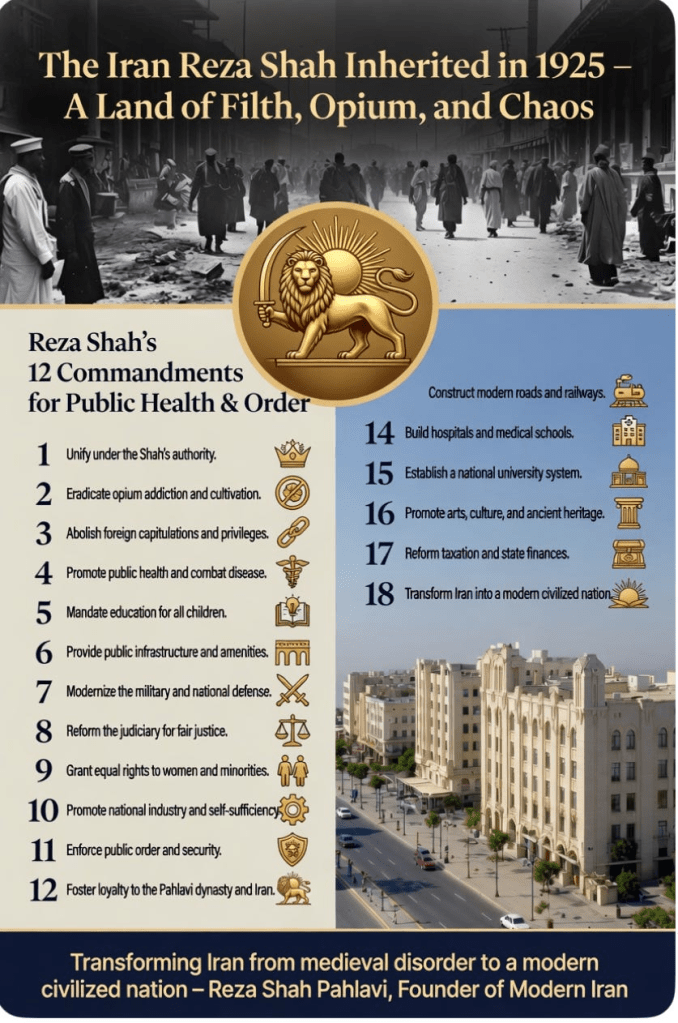
The Iran Reza Shah Inherited in 1925: A Land of Filth, Opium, and Chaos
Upon ascending the throne, Reza Shah inherited a country trapped in near-medieval conditions following decades of Qajar weakness:
- Public hygiene was almost nonexistent: Major cities like Tehran featured streets littered with human and animal waste, routine open defecation and urination, open animal slaughter in markets and alleys (with blood and carcasses left to rot), and widespread garbage accumulation.
- Widespread opium addiction: Public opium and shireh consumption in coffee houses, streets, and homes constituted a severe public health crisis affecting broad segments of society.
- Lack of basic order and sanitation: Food shops had unpaved, filthy floors; bread was placed directly on the ground; public bath tanks (khazineh) contained unchanged, stagnant water; stray dogs roamed freely; pigeon flying created nuisances; and street activities like professional begging, snake charming, and fortune-telling were commonplace.
- Broader national state: Illiteracy exceeded 90%, extreme poverty prevailed, tribal khans and nomads fragmented authority, British and Russian influence dominated, the army was weak and disorganized, roads were mere dirt tracks, and there was no effective central government or modern infrastructure.
Reza Shah’s 12 Commandments: Initial Steps Toward Public Health and Order
Shortly after coronation, Reza Shah issued these 12 Commandments as practical measures to impose basic cleanliness, health standards, and urban order. Enforced rigorously with fines and penalties, they formed the bedrock of his modernization campaign.
Reza Shah’s 12 Commandments for Public Health & Order:
- The consumption of opium and shireh (opium extract) is strictly prohibited, even inside coffee houses.
- Slaughtering animals (sheep, chickens, roosters, etc.) in public view or on the streets is completely forbidden.
- No one is permitted to relieve themselves (urinate or defecate) in public streets or pathways.
- Knife-fighting, brawling, shouting, and carrying knives, daggers, or swords will be severely punished.
- Blind people must wear a yellow armband and carry a cane for their own safety and others’.
- All domestic dogs must be kept on a leash and collar at all times.
- Pigeon flying (as a public hobby) is strictly prohibited.
- Every shopkeeper (except bakers, head cooks, and bathhouse attendants) must open their shop at sunrise and close at sunset.
- Every baker must build a brick platform for fresh bread coming out of the oven so it does not touch the ground.
- Every food seller must pave the floor of their shop with bricks and clean it every day.
- The water in public bath tanks (khazineh) must be fully changed every week.
- Street performances such as snake charming, juggling, professional begging, fortune-telling, amulet writing, vagrancy, and other public nuisances are forbidden.
These measures rapidly improved urban spaces, creating a foundation for broader progress.
Resistance to Reform: The Public Bath Rebellion (جنبش خزینه / Khazineh Movement)
Basic hygiene initiatives met stiff opposition, exposing societal backwardness. The public bath rebellion (جنبش خزینه / Khazineh Movement) arose when the government moved against traditional khazineh—stagnant, shared water pools notorious for spreading disease—and promoted modern individual shower baths (dush). Mullahs and conservatives protested vehemently, portraying the changes as assaults on Islamic tradition. This was not abstract debate but literal resistance to clean water and epidemic control in favor of filthy communal practices. Such revolts underscored the medieval mindset Reza Shah confronted: deep superstition and clerical pushback against even elementary sanitary advances required firm state enforcement.
Economic Foundations: Oil Revenues, National Banking, and Monetary Sovereignty
Reza Shah’s modernization required stable finances. He renegotiated the exploitative 1901 D’Arcy oil concession with the Anglo-Persian Oil Company (later Anglo-Iranian). In 1932 he unilaterally canceled the original agreement; after League of Nations mediation, the 1933 concession reduced the concession area by about 80%, extended its term, but improved terms—including a lump-sum payment, royalties based on volume (4 shillings per ton plus profit shares), and commitments to employ more Iranians. Oil revenues rose steadily, providing growing resources (though still modest relative to total government income) to support infrastructure and the military.
Equally transformative was the creation of a sovereign banking system. In 1927–1928, Reza Shah established Bank Melli Iran (National Bank of Iran) as the country’s first fully Iranian-owned national institution. It assumed central banking functions previously held by the British-controlled Imperial Bank of Persia, including the exclusive right to issue banknotes (previously printed under foreign concessions) and control over currency and foreign exchange. This enabled the government to print its own currency—featuring Reza Shah’s image—and regulate monetary policy independently, ending decades of foreign financial dominance. Additional institutions like the Agricultural Bank followed, supporting broader economic development.
Social Reforms: Emancipation of Women and Equality for Religious Minorities
Reza Shah’s modernization extended deeply into social spheres, challenging traditional hierarchies and promoting secular national identity.
Emancipation of Women: He pursued policies that radically altered women’s lives, linking gender equality to national progress. Key steps included expanded educational opportunities: women received financial support to study abroad (from 1928), were admitted to the University of Tehran (from 1935), and benefited from compulsory primary and secondary education. The most visible and controversial reform was the mandatory unveiling (Kashf-e hijab) proclaimed in January 1936 at the Tehran Teachers College. Reza Shah, influenced by his 1934 visit to Turkey, banned the chador and encouraged European-style attire, with the royal family publicly demonstrating the change. The Ladies’ Center (Kanoun-e-Banovan), established in 1935 under figures like Hajar Tarbiat and other women activists, campaigned for unveiling and women’s welfare, later evolving into an educational and welfare institution. These measures faced resistance from conservative and clerical elements but opened doors for women in teaching, nursing, office work, and public life, marking a decisive break from seclusion and veiling norms.
Rights for Religious Minorities: Reza Shah enforced and expanded the equal rights granted during the Constitutional Revolution, repealing discriminatory Qajar-era laws against non-Muslims. Jews, in particular, benefited significantly. All restrictions barring Jews from certain neighborhoods, occupations, or military service were lifted. They gained the right to serve in the armed forces, enroll in state schools, and hold government positions. Jewish communities were permitted to operate their own schools—such as those affiliated with the Alliance Israélite Universelle—where Hebrew could be taught alongside Persian and other languages, supporting cultural and religious education. Reza Shah personally visited Jewish schools (e.g., in Hamadan in 1936), signaling state support. Similar protections extended to other recognized minorities, including Armenians, Assyrians, and Zoroastrians, with reduced clerical influence in judiciary and education fostering greater inclusion. Overall, his secular policies promoted no official discrimination against religious minorities, advancing integration while preserving communal institutions like synagogues, schools, and philanthropies. This created a more tolerant environment, often described as a foundational shift toward a modern, multi-confessional nation.
Broader Achievements: Building a Modern Nation-State
Reza Shah’s reforms spanned multiple domains:
- Military: A professional national army exceeding 100,000 troops with universal conscription, modern equipment, and Iranian command replaced fragmented forces.
- Infrastructure: Road network expanded dramatically; the Trans-Iranian Railway (completed 1938) connected the Caspian to the Persian Gulf without foreign loans.
- Education and secularization: Compulsory schooling, founding of the University of Tehran (1934–35), and reduction of clerical control over education began raising literacy.
- Judiciary and administration: Secular legal codes replaced Sharia courts; a professional bureaucracy emerged; capitulations were abolished in 1928.
- Industry and economy: State factories multiplied; import substitution and industrialization advanced; tribal sedentarization promoted unity.
- National identity: He officially changed “Persia” to “Iran” in 1935, emphasizing pre-Islamic heritage.
All were pursued with determination, sometimes ruthlessly, against opposition from tribes, clerics, and conservatives.
Conclusion: Dragging Iran Out of the Middle Ages
Reza Shah inherited a collapsing, backward country beset by filth, chaos, opium, tribal fragmentation, foreign interference—and violent religious resistance to basic reforms like the Khazineh Movement. From his improbable rise through the ranks and grueling campaigns like Khuzestan, he centralized power and launched sweeping modernization. The 12 Commandments addressed immediate urban disorder; oil renegotiations and the creation of Bank Melli (which took over note issuance from foreign hands) provided economic tools; infrastructure, education, military, and social changes—including women’s emancipation via unveiling and expanded rights, plus equality for religious minorities such as allowing Jewish schools to teach Hebrew without discrimination—built a cohesive nation-state. Through vision and resolve, he dragged Iran from medieval conditions into the 20th century—often against fierce opposition—laying institutions and infrastructure whose legacy shaped modern Iran.
Young Islamist revolutionary (terrorist ) ZibaKalam and older Professor ZibaKalam:
A former young Islamic revolutionary—trained in Islamist Palestinian-Libyan camps, later a prominent professor in the Islamic Republic—says this. You can hear his younger self in English, and the older ZibaKalam in Farsi. I have the translation below.
Translation:
The Shah’s government did not carry out killings or massacres, despite what has been claimed before and after the revolution. I have shown this with facts, numbers, and statistics in my book, “The Shah Did Not Commit Massacres.” He could have certainly done so, but he did not order his army to carry it out.
I am convinced the revolution in 1979 was successful because his government did not commit killings. This has always made me wonder why.
The Shah had the ability to use force and suppress the uprising violently, but he chose not to order the army to carry out mass killings.
He argues that this restraint was one of the main reasons the 1979 revolution succeeded.
He then reflects on why the Shah acted this way. In his view, two factors played a role:
1.The Shah was terminally ill.
2.He did not trust the Americans and was suspicious of them, despite the commonly portrayed close relationship.
He concludes by describing the Shah as a very lonely figure at the end.
The video below is an interview with the Crown Prince Reza Cyrus Pahlavi. Make sure to listen to all parts, especially at the one hour and 14 minute mark and what Zbigniew Brzezinski says in 1978 to Reza Cyrus Pahlavi.
Click on this link to YouTube:

