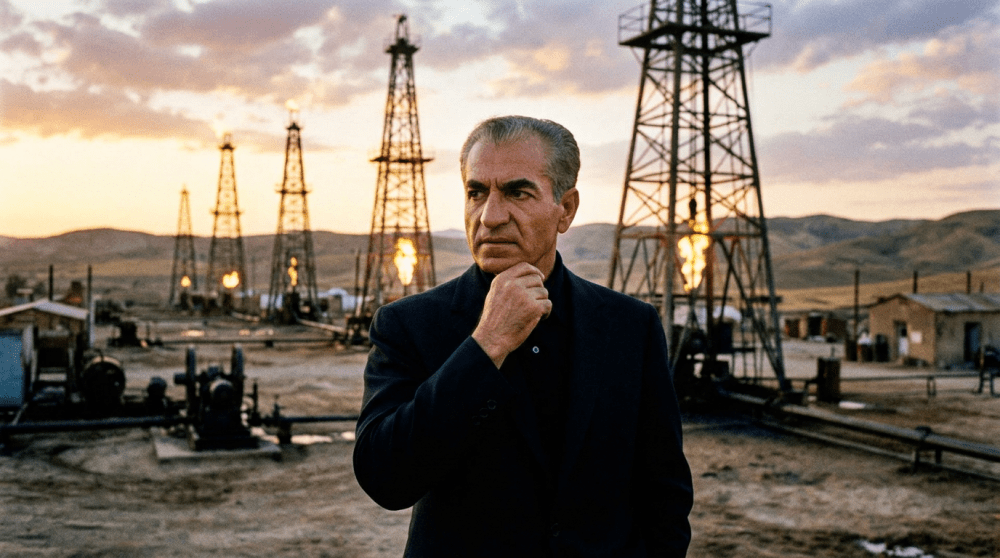
How the West Engineered the Shah’s Fall: Oil, Power & the Betrayal of Iran
Mohammad Reza Shah Pahlavi was once the West’s golden ally—a modernizer and a bulwark against communism. Yet, by the late 1970s, that relationship collapsed, with the West abandoning him at the moment of greatest need.
Why? A mix of oil politics, economic tensions, geopolitical shifts, and Western hypocrisy. 🧵👇
1️⃣ The Shah’s Oil Gamble & Western Backlash
🔹 In 1973, the Shah took full control of Iran’s oil industry, ending the 1954 consortium agreement that let Western companies profit off Iranian crude.
🔹 He then led OPEC to raise oil prices from $5.11 to $11.65 per barrel, triggering a 470% increase within a year.
🔹 His message to the West? “The era of cheap oil is over.”
🔹 Iran’s oil revenue quadrupled to $20.9 billion in 1974, fueling modernization. But in the West, it triggered economic chaos:
✅ U.S. oil imports surged from $3.9B to $24B in a year
✅ France’s unemployment rose from 2% to 6%
✅ Spain’s $500M trade surplus flipped into a $3.1B deficit
The Shah believed in Iran’s right to wealth, but Western leaders saw him as a problem.
2️⃣ The Shah’s Vision & Western Fear
🔹 The Shah didn’t just demand fair oil prices—he wanted the West to rethink energy consumption and invest in nuclear & solar power.
🔹 He openly criticized the West’s exploitative economics, stating:
🗣️ “You buy our crude oil and sell it back to us as refined petrochemicals at 100x the price.”
🔹 The West feared this “energy nationalism” would spread to other oil-producing countries.
🔹 His ambition? A post-oil future where Iran became an industrial powerhouse.
This was too much independence for the global order to handle.
3️⃣ The Carter Administration’s Pressure
🔹 Nixon supported the Shah’s military buildup, but Carter weaponized “human rights” to undermine him.
🔹 The Pentagon made Iran pay for its own military R&D, hiking costs.
🔹 As inflation hit the U.S. due to oil prices, Carter needed a scapegoat—and the Shah was it.
🔹 Instead of backing him against growing unrest, the U.S. cut support, emboldening his enemies.
4️⃣ Western Media & the Weaponization of “Human Rights”
🔹 The Shah’s modernization & secularization alienated:
✅ The clergy (who lost their power)
✅ Feudal landlords (who lost land in reforms)
✅ Leftists (who hated capitalism)
🔹 SAVAK’s suppression of dissidents was exaggerated & politicized by Amnesty International & Western media.
🔹 Meanwhile, Khomeini’s radicalism was whitewashed—he was sold as a spiritual leader, not a theocrat-in-waiting.
5️⃣ The Final Betrayal: 1978–79 Revolution
🔹 As protests erupted, the Shah hesitated—hoping the U.S. would help.
🔹 Carter’s response? Withholding support & pressuring the military to abandon him.
🔹 The U.S. & U.K. facilitated Khomeini’s return—knowing full well he would destroy Iran’s secular future.
🔹 When Khomeini took power, he dismantled everything the Shah built—but by then, the West had already moved on.
https://threadreaderapp.com/thread/1898900739365437854.html
xxxxxxxxxxxxxxxxxxxxxxxxxxxxxxxxxxxxxxxxxxxxxxxxxxxxxxxxxxxxxxxxxxxxxxxxxxxxxxxxxxxxxxxxxxxxxx
Showdown at Doha: The Secret Oil Deal That Helped Sink the Shah of Iran
Andrew Scott Cooper
What led to the calamitous drop in Iran’s oil revenues in January 1977? Politics, religion, culture, and economics have been identified as factors contributing to the collapse of Iran’s monarchy in 1979. But until now scholars have been unable
to access documents that could shed light on the inner workings of the relationship between senior US officials and the Shah of Iran, whom Henry Kissinger lauded as “that rarest of leaders, an unconditional ally, and one whose understanding of the world enhanced our own.”1
The declassification of the papers of Brent Scowcroft, who worked in the Nixon and Ford Administrations, marks a
significant milestone in our understanding of the origins of the Iranian Revolution. They reveal that in 1976 the US and Saudi Arabia colluded to force down oil prices, inadvertently triggering a financial crisis that destabilized Iran’s economy
and weakened the Shah’s hold on power. In the first nine days of January 1977, Iran’s economy was battered by unusual turbulence in international oil markets. Hundreds of millions of dollars in anticipated revenue were erased by a sudden and precipitous drop in daily oil exports, while total oil production plunged 38% over the previous month.2
Financial hemorrhaging forced the Shah’s government to rewrite its budget, cancel new spending projects, freeze foreign aid programs, and take out a $500 million emergency loan from US and European banks.3
The immediate cause of Iran’s fiscal crisis was Saudi Arabia’s bold decision to challenge an increase in oil prices agreed to by the rest of the Organization of Petroleum Exporting Countries (OPEC) at a December 1976 meeting in Doha, Qatar. The Saudi Oil Minister, Shaykh Ahmad Zaki Yamani, had announced that his government would offset the impact of the price hike by selling more of its own petroleum at a reduced price.4
Yamani’s threat to flood the market with cheap oil never came about, but OPEC’s two-tiered pricing system remained in effect for six months and dealt Iranian finances a grievous blow. The Shah’s chief economists later confirmed that the government had never considered the possibility of a steep drop in oil prices and production.5
It had overestimated oil revenues that never materialized and spent money it would now never see. But worse was to come. The government’s attempt to restore fiscal order only compounded the crisis. Its harsh deflationary budget led to high unemployment
and social unrest that “helped create a classic prerevolutionary situation.”6
The Shah’s personal reaction to the Saudi action was telling. Muhammad Reza Pahlavi had been counting on higher oil prices to buttress Iran’s anemic economy — and strengthen his hand — while he embarked on a highly risky course of political liberalization at home. “We’re broke,” he despaired on January 2, 1977. “Everything seems doomed to grind to a standstill, and meanwhile many of the programs we had planned must be postponed … It’s going to be very tough.”
- Henry A. Kissinger, White House Years (New York: Little Brown & Company, 1979), p. 1261.
- “Iran Reports Exports of Oil Decline 34.7%,” The New York Times, January 12, 1977. In January 1977 daily oil exports fell 34.5% over daily oil exports for December 1976 — the equivalent of 2
million barrels of oil a day. The drop in total oil production was 38%. “How the Opec Fight Will Be
Won,” The Economist, January 15, 1977, p. 78. - “Iran Confirms Oil Output Slump,” The Times, January 28, 1977 and “Shah Feels Pinch From
Loss of Exports,” The Times, February 18, 1977. For details of the bank loan see “Iran’s Cabinet
Agrees On a $500 Million Loan To Narrow Its Deficit,” The New York Times, January 17, 1977. - Yamani went so far as to threaten an increase in Saudi production of 50%. “Yamani Says Saudis
Can Raise Output of Oil By 50%,” The New York Times, January 15, 1977 - Hossein Razavi and Firouz Vakil, The Political Environment of Economic Planning in Iran,
1971-1983: From Monarchy to Islamic Republic, Westview Special Studies on the Middle East (Boulder and London: Westview, 1984), p. 90. Dr. Hossein Razavi served as a Bureau Director at the Plan
and Budget Organization of Iran from 1976 through November 1981. Dr. Firouz Vakil worked at the
Plan and Budget Organization of Iran from 1973-79. In exile they produced the definitive account of
Iran’s budgetary and financial procedures in the 1970s. Their slim volume is essential reading and
scholars owe both authors a debt of gratitude. - Nikki R. Keddie with a section by Yann Richard, Roots of Revolution: An Interpretive History
of Modern Iran (New Haven and London: Yale University Press, 1981), p. 177.
To read the rest of this article, please click on the link below:
https://www.suren-pahlav.com/pdf/showdown_at_Doha-The_Secret_Oil_Deal_That_Helped_Sink_the_Shah_of_Iran.pdf

