The Mission That Became Abandonment
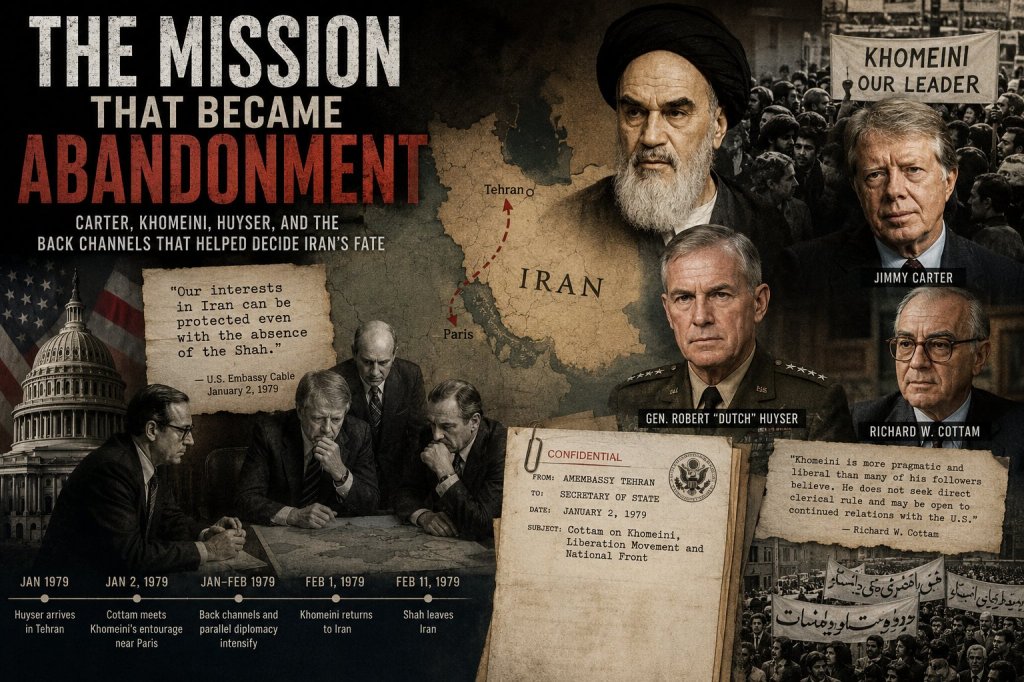
Carter, Khomeini, Huyser, and the Back Channels That Helped Decide Iran’s Fate
In the final weeks of the Iranian monarchy, Washington was speaking in two voices.
One voice assured the Shah, Prime Minister Shapour Bakhtiar, and the commanders of the Iranian armed forces that the United States still supported stability, constitutional government, and the survival of the state.
The other voice was already reaching beyond them.
It was speaking quietly with Ayatollah Ruhollah Khomeini’s representatives outside Paris. It was testing contacts inside the Iranian opposition. It was asking whether American interests, oil supplies, military agreements, and diplomatic relations could survive the disappearance of the Shah.
This was not necessarily a grand conspiracy designed in a single room. History is rarely that orderly.
It was something more familiar and, in some ways, more dangerous: a superpower hedging its bets while a vulnerable ally was still being told that help was coming.
The consequences would last for generations.
The part of the Carter story that is often told
In his influential 2021 Foreign Affairs essay, “The Other Carter Doctrine,” Ray Takeyh focuses heavily on President Jimmy Carter’s December 1979 finding authorizing covert efforts against the newly established Islamic Republic.[1]
That later chapter matters. By then, the American Embassy had been seized, U.S. diplomats were hostages, and Washington had begun reconsidering the regime it had initially hoped might prove manageable.
But the emphasis on December 1979 can obscure the more consequential decisions made almost a year earlier.
In January 1979, the Shah was still in Iran. Bakhtiar was still trying to preserve constitutional government. The armed forces still possessed the capacity to defend the state. Yet Washington was already receiving assurances from Khomeini’s circle and considering the possibility of an orderly post-Shah relationship.
That was the earlier Carter doctrine: not yet regime change against the Islamic Republic, but accommodation with the forces preparing to create it.
A general sent to “save” an army or Prevent a Coup?
General Robert “Dutch” Huyser arrived in Tehran in January 1979 as the Iranian state was coming apart.
Officially, his mission was to maintain the unity of the Iranian armed forces, prevent a premature military coup, support Bakhtiar’s government, and avoid chaos.
But the officers he met were watching the political foundation beneath them disappear.
Their commander-in-chief was leaving the country. The United States was sending mixed messages. Khomeini’s return was being treated as increasingly inevitable. Senior military commanders were being asked to remain calm while the revolutionary movement expanded its power.
Huyser later published a careful and restrained account of his mission. That was not surprising. He was a career officer writing about one of the most controversial assignments of his life.
The more emotional account emerged elsewhere.
Mike Evans has said that Huyser later spoke privately about the anguish and guilt he carried over Iran. According to Evans, Huyser believed he had been sent under the premise of supporting the Iranian military but had, in practice, helped neutralize it at the decisive moment.[2,3]
Evans’ account cannot independently prove every private statement attributed to Huyser. But it becomes more plausible when read alongside what is now known about Washington’s contacts with Khomeini’s representatives, its restrictions on the Iranian generals, and its willingness to contemplate a post-Shah political order.
Empress Farah Pahlavi has also described Huyser’s later distress over the role he had played. Her account fills an emotional gap that official memoranda rarely capture: the shock of officers who believed the United States was standing beside them, only to discover that Washington was preparing for a different future.
Sanitized cables record positions.
They rarely record betrayal as it was felt by the people in the room.
The intermediary almost missing from the story
One of the most important figures in this story was neither a senior diplomat nor a serving intelligence officer.
His name was Richard W. Cottam.
Cottam was often presented publicly as a professor and Iran specialist. But his connection to Iran went much deeper.
He had joined the Central Intelligence Agency in the 1950s and served in Tehran under diplomatic cover as a political officer at the U.S. Embassy. During those years, he developed relationships with Iranian nationalists, members of the National Front, and opponents of the Shah.
Cottam resigned from the CIA in 1958 and later became a professor at the University of Pittsburgh. But his contacts did not disappear when his official intelligence career ended. He remained deeply connected to opposition networks, including figures associated with the National Front and the Liberation Movement.[4]
By late 1978, those relationships had become strategically valuable.
Cottam met Khomeini and members of his entourage near Paris. He then traveled to Tehran and briefed American officials on what he had heard.
A confidential U.S. Embassy cable dated January 2, 1979, carried the revealing title: “Cottam on Khomeini, Liberation Movement and National Front.”
Cottam’s assessment was reassuring.
He described Khomeini as more pragmatic and liberal than many Iranian intellectuals believed. He suggested that the clerical leadership might not intend to govern directly. He conveyed the impression that Khomeini’s movement was prepared to consider continued relations with the United States.[5]
These were not minor observations.
They supported a growing belief inside parts of the Carter administration that Khomeini could be dealt with—that his movement could be moderated, contained, or incorporated into a stable political order after the Shah.
Not everyone agreed.
Another White House assessment noted that visitors to Khomeini’s circle had encountered a far more hierarchical environment than the egalitarian image conveyed by Cottam. The atmosphere around Khomeini suggested command and obedience, not merely spiritual guidance.[5]
But Cottam’s influence was not limited to analysis.
Research based on declassified documents indicates that he helped establish contact between U.S. Embassy political officer John Stempel and Abbas Amir-Entezam, a prominent member of the Liberation Movement who would later serve in Mehdi Bazargan’s provisional government.[6]
According to an account preserved in the Iranian oral-history archive, Cottam also attended a confidential gathering involving central revolutionary figures in a building on Tehran’s Tohid Street. The meeting was connected to the Revolutionary Council and the decision-making circle surrounding the revolution.
That specific account should be attributed to the archive in which it appears. But it fits a larger documentary pattern that is no longer seriously disputable: Cottam had direct access to people near Khomeini and to figures who would soon occupy senior positions in the revolutionary government.
The continuity of that role became unmistakable after the revolution.
During the hostage crisis, senior American officials repeatedly identified Cottam as an informal channel to Foreign Minister Sadegh Ghotbzadeh and other leaders of the Islamic Republic. Official records show that he communicated regularly with Ghotbzadeh, met Bazargan, and was considered capable of reaching Mohammad Beheshti and other powerful figures inside the new regime.[7-10]
A former CIA officer with decades of access to the Iranian opposition became an influential informal intermediary. His reports, introductions, and communications helped shape Washington’s understanding of Khomeini’s movement.
Cottam did not have to engineer the revolution to affect its course.
He only had to persuade decision-makers that the men waiting to inherit Iran were more pragmatic than they appeared.
The secret conversation with Khomeini
The Carter administration’s contacts with Khomeini’s representatives are no longer matters of speculation.
Declassified communications show that Khomeini’s circle was sending carefully calibrated assurances to Washington.
They indicated that a new government would not threaten American interests. They suggested that oil would continue to flow. They signaled that military and economic relations need not collapse. They portrayed the transfer of power as something that could occur without chaos or fundamental hostility toward the United States.[11]
The language was designed to calm.
Khomeini’s representatives were not presenting the movement as a revolutionary theocracy that would execute senior officers, eliminate political rivals, seize the American Embassy, export Islamist militancy, and reorganize the Iranian state around clerical supremacy.
They were offering stability.
They were offering continuity.
They were offering precisely what anxious policymakers wanted to hear.
The central failure was not that Washington spoke to the opposition. Governments often communicate with all sides during a crisis.
The failure was treating those assurances as evidence that the opposition’s ultimate objectives were limited and manageable.
The Shah who would not order a bloodbath
The Shah has often been portrayed as a blood-soaked tyrant driven from power by a united population.
The historical record is more complicated.
In his review of Andrew Scott Cooper’s The Fall of Heaven, David Holahan described Mohammad Reza Shah Pahlavi as a “serious ruler” .[12,13]
The White Revolution expanded literacy, increased incomes, redistributed land, widened access to education and healthcare, and advanced the legal and social position of women.
This was not a ruler presiding over a motionless country.
It was a ruler attempting to transform one.
The speed of that transformation created tensions the state did not always understand or manage effectively. But it also produced a generation with rising expectations—more education, greater mobility, urbanization, political awareness, and demands that were themselves partly products of modernization.
Holahan also emphasized a trait that complicates the standard caricature of the Shah: his reluctance to use unlimited violence.
He was, in Holahan’s phrase, “something of an old softy.”
He repeatedly offered concessions. He changed governments. He loosened controls. He permitted criticism. He hesitated to unleash the full force of the military against demonstrators.
That hesitation would prove fatal to his rule.
In late 1978, King Hussein of Jordan flew to Iran to support his fellow monarch.
According to the account later reported, Hussein offered to take command personally and lead the Iranian army against the revolutionaries.
The Shah declined.
King Hussein understood the refusal as a sign that his friend and mentor had already decided not to save the Peacock Throne through mass bloodshed.
He would not slaughter his people to remain king.
That decision is often described as weakness. It can also be understood as a moral boundary.
The Shah did not flee in blind panic. He stepped aside after concluding that retaining power would require a level of violence he was unwilling to authorize.
A country transformed too quickly
Iran in the late 1970s was caught between worlds.
It possessed modern industries, universities, expanding cities, a large military, ambitious development projects, and a state determined to accelerate modernization.
But large parts of the country still carried the legacies of low rural literacy, traditional patronage, clerical authority, bazaar networks, and social structures formed long before modern mass politics.
The result was a society experiencing what political theorists often describe as a J-curve dynamic: expectations rise during rapid improvement, then anger intensifies when progress abruptly slows.
For years, oil income had financed development on an enormous scale.
Then the engine began to falter.
Andrew Scott Cooper’s research describes the consequences of the Ford administration’s cooperation with Saudi Arabia in the mid-1970s to restrain or lower oil prices. The policy placed intense pressure on Iran’s development model and weakened the Shah after his confrontation with Washington over oil pricing.[14]
Iranian oil sales suffered a sharp short-term fall. In early 1977, declines of approximately one-third were reported in some comparisons. Projects were cut or postponed. Reserves came under pressure. A state that had recently extended billions of dollars in credit to European governments began considering external borrowing and imposing austerity.
The precise annual figures require care. Iran’s total annual oil revenues did not decline by 30 to 40 percent between 1976 and 1977; estimates place revenues at roughly $22.9 billion in 1976 and approximately $23.6 billion in 1977. The more defensible argument concerns the abrupt decline in sales, expected income, and available development financing during critical periods—not a 40 percent collapse in total annual revenue.
But the political effect was real.
An economy designed around continuous expansion was suddenly forced to slow. Construction projects stalled. Credit tightened. Inflation and shortages created public anger. The state was required to reverse course precisely when expectations were highest.
Was the pressure deliberately designed to weaken the Shah?
The documentary record shows strategic conflict over oil policy. It does not conclusively establish a single coordinated plan to destroy the Iranian monarchy.
The reader will have to judge the pattern.
The revolution was not inevitable
By the final months, Iran was in crisis. But collapse was not yet unavoidable.
The armed forces remained one of the strongest institutions in the region. The revolutionary coalition was broad but internally divided. Khomeini’s clerical movement had not yet built the machinery of the Islamic Republic. Bakhtiar was attempting to preserve the constitution, political pluralism, and the monarchy while creating space for reform.
A unified military position, supported by clear American resolve, might have bought time.
Time for Bakhtiar to govern.
Time for the revolutionary coalition to fracture.
Time for Khomeini’s assurances to be tested.
Time for the Iranian public to see the difference between constitutional reform and theocracy.
Instead, the military received uncertainty.
The generals were discouraged from decisive action. The Shah left the country. Khomeini returned. The armed forces declared neutrality on February 11, 1979.
The state collapsed almost immediately.
Javad Khadem, a minister in Bakhtiar’s government, later argued that Bakhtiar was not ultimately committed to preserving the monarchy’s institutional legacy and that the government functioned less as a platform for resistance than as a bridge toward trafer.[15]
That interpretation remains contested. But the practical outcome is clear: the transitional government did not stop Khomeini’s seizure of power.
It facilitated the space in which it occurred.
Huyser’s burden
This is what gives the Huyser story its force.
Evans does not describe a general boasting that he had overthrown the Shah.
He describes a man haunted by the possibility that his mission had been presented as support but operated as abandonment.
Huyser’s published memoir remained disciplined and careful. His alleged private anguish was different. It reflected the emotional truth of an officer who had watched a powerful military institution stand down while revolutionary forces moved to destroy it.
That anguish is consistent with the larger record.
American officials had restrained the military while opening channels to the opposition. They had publicly supported Bakhtiar while privately assessing how relations might continue after his failure. They had accepted assurances from Khomeini’s representatives while the Iranian commanders who trusted Washington were being isolated.
The Islamic Republic later executed many of those officers. My father being one of them.
They had obeyed requests for restraint.
Their enemies did not.
Carter’s zigzag
Carter’s Iran policy moved between incompatible objectives.
He pressed the Shah on human rights and political liberalization.
He affirmed the Shah as an ally.
He welcomed reform.
He feared instability.
He opposed a military takeover.
He supported Bakhtiar.
He communicated secretly with Khomeini’s circle.
He hoped the army would remain intact.
He discouraged it from acting decisively.
Then, after the revolution consolidated and the American hostages were taken, his administration authorized covert measures against the regime it had previously hoped to accommodate.
This was not strategic flexibility.
It was a sequence of contradictory signals delivered during a rapidly closing window.
By the time Washington became hawkish, the Iranian state had already been destroyed.
The warning for today
The historical parallel is difficult to ignore.
Today, senior figures inside the Islamic Republic again present themselves to Washington as pragmatic intermediaries capable of delivering stability.
Parliament Speaker Mohammad Bagher Ghalibaf is a former commander of the Islamic Revolutionary Guard Corps with a documented role in the Islamic Republic’s coercive apparatus and violent crackdowns.
Foreign Minister Abbas Araghchi is a veteran regime diplomat and nuclear negotiator associated with years of broken commitments, sanctions disputes, and efforts to preserve the system through negotiations.
They speak the language of realism.
They offer formulas such as “commitment for commitment.”
They suggest that fundamental problems can be managed.
They present themselves as the responsible alternative to escalation, collapse, or chaos.
The script is familiar.
In January 1979, Khomeini’s representatives also assured Washington that American interests could be protected, stability maintained, and relations normalized.
The words were not meaningless. They were tactical.
They served the immediate purpose of easing American resistance while the revolutionary movement completed its seizure of power.
Today’s regime insiders are not external reformers preparing to replace the Islamic Republic. They are products and defenders of the same system. They have spent decades preserving the institutions that executed the generals, imprisoned dissidents, exported terrorism, and destroyed Iran’s political and economic foundations.
They may disagree over tactics.
They do not represent a clean break with the regime.
The danger of the transitional façade
Bakhtiar’s government was presented as a constitutional transition.
In practice, it lacked the time, military backing, and international resolve necessary to survive.
Today, another managed transition could be offered to Washington: new faces, softer language, partial economic concessions, temporary agreements, or the elevation of regime insiders presented as pragmatic national figures.
The danger is not only that such figures may lie.
The deeper danger is that American policymakers may again hear exactly what they need to hear.
Stability.
Continuity.
No fundamental conflict.
Protection of Western interests.
A manageable transition.
Time for diplomacy.
In 1979, those assurances helped lower the cost of Khomeini’s advance.
The Islamic Republic then spent decades proving how false the underlying assumptions had been.
Trust the pattern, not the polished words
President Donald Trump and his administration should not repeat Carter’s central error: treating tactical assurances from a regime in crisis as evidence of strategic moderation.
The lesson from the declassified record is not that every negotiation is betrayal or that every diplomatic contact is evidence of conspiracy.
The lesson is that words offered by revolutionary or authoritarian actors must be measured against their ideology, organization, record, incentives, and capacity for deception.
Javad Khadem’s retrospective testimony, Huyser’s reported guilt, Carter’s secret exchanges with Khomeini’s circle, Cottam’s reassuring assessments, and the documentary record of early American engagement form a consistent pattern.
Washington was preparing to accommodate Khomeini before the constitutional government had been given a genuine opportunity to survive.
Today, amid currency collapse, electricity shortages, water scarcity, public desperation, and a profound crisis of legitimacy, the Islamic Republic is again attempting to buy time.
Its representatives seek sanctions relief, diplomatic legitimacy, internal consolidation, and the appearance of international acceptance.
The danger is not that history will repeat itself in exactly the same form.
It never does.
The danger is that the same assumptions will return:
That the men offering reassurance are more pragmatic than their institutions.
That temporary restraint represents permanent change. That a managed accommodation will preserve stability. That the opposition to a collapsing regime is too uncertain to support.
That the existing power structure, however brutal, remains the safest available option.
Those assumptions helped deliver Iran to Khomeini.
They should not be allowed to preserve the system he created.
What the record ultimately shows
Mike Evans’ account does not require belief in an elaborate plot.
It records what Huyser may have experienced: a mission presented as support that became, in practice, the neutralization of Iran’s last functioning line of defense.
The collapse of the Pahlavi state was not caused by one man, one embassy, or one decision. It resulted from internal weaknesses, economic shocks, revolutionary organization, clerical networks, political hesitation, the Shah’s illness, and serious American policy failures during the final chapter.
The house the Pahlavis built was modernizing rapidly, but parts of its political foundation remained fragile due to parallel power structure Khomeni had built in earnest since 1965.
The Shah’s refusal to order mass slaughter reflected both his humanity and his vulnerability.
Carter’s mixed signals magnified that vulnerability.
Khomeini’s representatives exploited it.
The United States discovered too late that the forces it had hoped to manage had no intention of honoring the political assumptions that made their victory easier.
History’s pivotal moments rarely arrive with complete documentation or clean moral choices.
They arrive through private meetings, ambiguous orders, reassuring cables, exhausted leaders, and decisions that appear temporary until they become irreversible.
That is what happened in Iran.
And that is why the promises being made today must be judged not by their polish, but by the history of the system speaking through them.
References
- Takeyh R. The other Carter doctrine: Jimmy Carter’s secret program for regime change in Iran—and what it means for US policy today. Foreign Aff. 2021 Feb 26.
- Evans M. Jimmy Carter: The Liberal Left and World Chaos: A Carter/Obama Plan That Will Not Work. Phoenix: TimeWorthy Books; 2009.
- Evans M. The prince of Persia [Internet]. Times of Israel Blogs; 2026 [cited 2026 Apr 30]. Available from: https://blogs.timesofisrael.com/the-prince-of-persia/
- Gasiorowski MJ. Cottam, Richard. Encyclopaedia Iranica [Internet]. Available from: https://www.iranicaonline.org/articles/cottam-richard-1/
- Simpson GL. Seeking Gandhi, finding Khomeini: How America failed to understand the nature of the religious opposition of Ayatollah Ruhollah Khomeini in the Iranian Revolution. J Middle East Afr. 2017.
- Gasiorowski MJ. US intelligence assistance to Iran, May-October 1979. Middle East J. 2012.
- United States Department of State. Summary of a special meeting: formal and informal negotiating channels. Foreign Relations of the United States, 1977-1980. Vol XI, Part 1.
- United States Department of State. Memorandum concerning communications through Richard Cottam and Sadegh Ghotbzadeh. Foreign Relations of the United States, 1977-1980. Vol XI, Part 1.
- United States Department of State. Memorandum recording Richard Cottam’s meetings with Mehdi Bazargan and Sadegh Ghotbzadeh. Foreign Relations of the United States, 1977-1980. Vol XI, Part 1.
- United States Department of State. Strategy memorandum identifying Richard Cottam’s contacts with Sadegh Ghotbzadeh, Mohammad Beheshti and other Iranian officials. Foreign Relations of the United States, 1977-1980. Vol XI, Part 1.
- Declassified US diplomatic communications concerning the January 1979 contacts between the Carter administration and representatives of Ayatollah Khomeini.
- Holahan D. The Shah’s legacy [Internet]. 2016 [cited 2026 Apr 30]. Available from: https://davidholahan.com/bookreviews/the-shah-s-legacy
- Cooper AS. The Fall of Heaven: The Pahlavis and the Final Days of Imperial Iran. New York: Henry Holt and Company; 2016.
- Showdown in Doha: The Secret Oil Deal That Helped Sink the Shah of Iran [Internet]. Available from: https://www.suren-pahlav.com/pdf/showdown_at_Doha-The_Secret_Oil_Deal_That_Helped_Sink_the_Shah_of_Iran.pdf
- Abdi Media. Javad Khadem: Bakhtiar did not seek to preserve the legacy of the monarchy [Internet]. 2024 Sep 24 [cited 2026 Apr 30]. Available from: https://abdimedia.net/en/conversation/javad-khadem/javadkhadem-13
- Cooper AS. Enduring myths of the 1979 Iranian Revolution [Internet]. Middle East Institute; 2024 Feb 13 [cited 2026 Apr 30]. Available from: https://mei.edu/publication/enduring-myths-1979-iranian-revolution
- C-SPAN. Mike Evans interview concerning Jimmy Carter, General Robert Huyser and the Iranian Revolution. Book TV.
- Evans M. Interviews and accounts regarding General Robert Huyser’s testimony. Jerusalem Prayer Team publications and related writings.

