Posted on by adara press
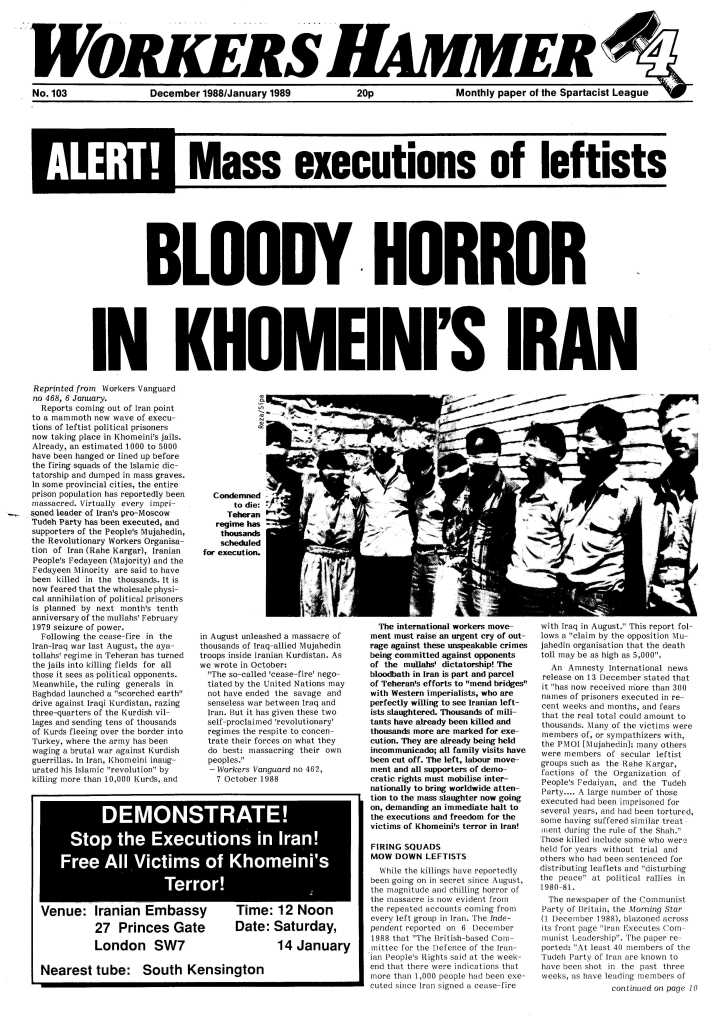
Leftists were key to bringing about the Islamic Revolution in Iran…not long after they were executed in thousands by their Islamic allies they helped bring to power as reported in this Leftist publication in 1988, now long forgotten….
A 30 November report of the representative in Europe of the Fedayeen Majority denounces the “extensive massacre, resembling only those seen in Nazi death camps”. “The massacre of political prisoners has taken place in the prisons of Tehran, Isfahan, Kerman, Khoram Abad, Gilan, Mazandaran, Hamendan, Gachsaran, Oromieh, Tabriz” and other cities. “Three hundred political prisoners have been buried in two mass graves in Khaavaraan cemetery (in East Tehran)…. In addition to daily execution of groups of political prisoners in Evin, a large number of them were murdered in a deliberate explosion and destruction of an auditorium where they had been assembled.”
And a 21 September 1988 statement of the Kurdistan Organisation of the Communist Party of Iran (Komala) said of the criminal mass executions of the “Islamic Republic”: “These turbaned dictators are looking for victory in the city streets and in prison cells to make up for their defeat in the war fronts of Iran and Iraq. They are trying desperately to extend their onerous life through terror and intimidation by setting up execution squads.”
From Moscow, Literaturnaya Gazeta (21 December 1988) reported on the “Massacre in Iran”, interviewing Iranian exile Bizhan Ekrami, who told of “an actual genocide” that was killing “the best sons of Iran”. Ekrami had a typed list of 147 names of activist, members of the intelligentsia and cultural figures, only a small fraction of those killed. “Iran is in mourning”, he said. There have also been protests in Iran in the midst of this reign of terror. Die Wahrheit (30 December 1988), the organ of the Socialist Unity Party of West Berlin, reports that, according to information from the Muhahedin, “a large number of relatives of executed oppositionists held a sitdown strike in front of the Ministry of Justice in Teheran on Tuesday to protest mass executions in Iran.”
Once again, the Left are aligning themselves with Islamic extremists.
Once again, they protest in defense of Iran’s killer clerics…led by the Ramsey Clark’s International Action Center, Medea Benjamin’s Code Pink, and DemocracyNow among others.
Perhaps, one day the ‘woke’ followers of these Progressive ‘thought leaders’ should heed the tortured cries of their ideological kin coming from Iran’s mass graves, and wake-up to the deadly horrors they are helping to engender…and to which, one day, they too will likely fall victim as they are, already, in Europe.
Is it any wonder than the old Nazi general Otto-Ernst Remer would only a few years later in 1993 laud Iran in an interview he gave to the Egyptian paper Al-Shaab:
“The Islamic system of Persia [Iran] is the only legitimate form of government of the muslim world…”
xxxxxxxxxxxxxxxxxxxxxxxxxxxxxxxxxxxxxxxxxxxxxxxxxxxxxxxxxxxxxxxxxxxxxxxxxxxxxxx
ALERT! Mass executions of leftists
BLOODY HORROR IN KHOMEINI’S IRAN
Reprinted from Workers Vanguard no 488, 6 January.
Reports coming out of Iran point to a mammoth new way of executions of leftist political prisoners now taking place in Khomeini’s jails. Already, an estimated 1000 to 5000 have been hanged or lined up before the firing squads of the Islamic dictatorship and dumped in mass graves. In some provincial cities, the entire prison population has reportedly been massacred. Virtually every imprisoned leader of Iran’s pro-Moscow Tudeh Party has been executed, and supporters of People’s Mujahedin, the Revolutionary Workers Organization of Iran (Rahe Kargar), Iranian People’s Fedayee (Majority) and the Fedyaee Minority are said to have been killed in the thousands. It is now feared that the wholesale physical annihilation of political prisoners is planned by next month’s tenth anniversary of the mullah’s February 1979 seizure of power.
Following the cease-fire in the Iran-Iraq war last August, the ayatollah’s regime in Teheran has turned the jails into killing fields for all those it sees as political opponents. Meanwhile, the ruling generals in Baghdad launched a “scorched earth” drive against Iraqi Kurdistan, razing three-quarters of the Kurdish villages and sending tens of thousands of Kurds fleeing over the border into Turkey, where the army has been waging a brutal war against Kurdish guerillas. In Iran, Khomeini inaugurated his Islamic “revolution” by killing more than 10,000 Kurds, and in August unleashed a massacre of thousands of Iraq-allied Mujahedin troops inside Iranian Kurdistan. As we wrote in October:
“The so-called ‘cease-fire’ negotiated by the United Nations may not have ended the savage and senseless war between Iraq and Iran. But it has given these two self-proclaimed ‘revolutionary’ regimes the respite to concentrate their forces on what they do best: massacring their own peoples.”
–Workers Vanguard no 462, 7 October 1988
The international workers movement must raise an urgent cry of outrage against these unspeakable crimes being committed against opponents of the mullahs’ dictatorship! The bloodbath in Iran is part and parcel of Teheran’s efforts to “mend bridges” with Western imperialists, who are perfectly willing to see Iranian leftists slaughtered. Thousands of militants have already been killed and thousands more are marked for execution. They are already being held incommunicado; all family visits have been cut off. The left, labour movement and all supporters of democratic rights must mobilise internationally to bring worldwide attention to the mass slaughter now going on, demanding an immediate halt to the executions and freedom for the victims of Khomeini’s terror in Iran!
FIRING SQUADS MOW DOWN LEFTISTS
While the killings have reportedly been going on in secret since August, the magnitude and chilling horror of the massacre is now evident from the repeated accounts coming from every left group in Iran. The Independent reported on 6 December 1988 that “The British-based Committee for the Defence of the Iranian People’s Rights said at the weekend that there were indications that more than 1,000 people had been executed since Iran signed a cease-fire with Iraq in August.” This report follows a “claim by the opposition Mujahedin organization that the death toll may be as high as 5,000”.
An Amnesty International news release on 13 December stated that it “has now received more than 300 names of prisoners executed in recent weeks and months, and fears that the real total could amount to thousands. Many of the victims were members of, or sympathizers with, the PMOI [Mujahedinl; many others were members of secular leftist groups such as the Rahe Kargar, factions of the Organization of People’s Fedaiyan, and the Tudeh Party…. A large number of those executed had been imprisoned for several years, and had been tortured, some having suffered similar treatment during the rule of the Shah.” Those killed include some who were held for years without trial and others who had been sentenced for distributing leaflets and “disturbing the peace” at political rallies in 1980-81.
The newspaper of the Communist Party of Britain, the Morning Star (1 December 1988), blazoned across its front page “Iran Executes Communist Leadership”. The paper reported: “At least 40 members of the Tudeh Party of Iran are known to have been shot in the past three weeks, as have leading members of
continued on page 10
(Continued from page 1)
the Iranian People’s Fedaian (Majority).” The article added that “in Evin, the main prison, there are rumours of mass killings, even the dynamiting of those jailed”. Among those killed were four Tudeh political bureau members including party deputy leader Farajollah Mitani, Manoucher Behzadi, editor of the party’s organ Nameh Mardom, Hossein Jodat and Ismail Zolqadr, as well as six central committee members and some 30 leading members of the party’s clandestine organisation.
Earlier, the Tudeh News (26 October and 23 November 1988) reported that political prisoners had been executed, especially Tudeh members as well as Fedayeen and Mujahedin supporters, after “having endured years of barbaric torture”. According to their families, the battered bodies of prisoners were buried in mass graves, some “so shallow that stray dogs can reach the bodies and tear them apart”. A 25 November “Statement of the Central Committee of the Tudeh Party of Iran” began, “We are reaching out for your help”, and listed names of those executed, including Hassan Jalali, member of the executive board of the Association of Trade and Labor Unions of Tehran and Vicinity, and more than a dozen others.
A 30 November report of the representative in Europe of the Fedayeen Majority denounces the “extensive massacre, resembling only those seen in Nazi death camps”. “The massacre of political prisoners has taken place in the prisons of Tehran, Isfahan, Kerman, Khoram Abad, Gilan, Mazandaran, Hamendan, Gachsaran, Oromieh, Tabriz” and other cities. “Three hundred political prisoners have been buried in two mass graves in Khaavaraan cemetery (in East Tehran)…. In addition to daily execution of groups of political prisoners in Evin, a large number of them were murdered in a deliberate explosion and destruction of an auditorium where they had been assembled.”
And a 21 September 1988 statement of the Kurdistan Organisation of the Communist Party of Iran (Komala) said of the criminal mass executions of the “Islamic Republic”: “These turbaned dictators are looking for victory in the city streets and in prison cells to make up for their defeat in the war fronts of Iran and Iraq. They are trying desperately to extend their onerous life through terror and intimidation by setting up execution squads.”
From Moscow, Literaturnaya Gazeta (21 December 1988) reported on the “Massacre in Iran”, interviewing Iranian exile Bizhan Ekrami, who told of “an actual genocide” that was killing “the best sons of Iran”. Ekrami had a typed list of 147 names of activist, members of the intelligentsia and cultural figures, only a small fraction of those killed. “Iran is in mourning”, he said. There have also been protests in Iran in the midst of this reign of terror. Die Wahrheit (30 December 1988), the organ of the Socialist Unity Party of West Berlin, reports that, according to information from the Muhahedin, “a large number of relatives of executed oppositionists held a sitdown strike in front of the Ministry of Justice in Teheran on Tuesday to protest mass executions in Iran.”
And in New York, the “Committee in Solidarity with the People of Iran” (CISPI) published gruesome pictures of bodies thrown into the “Graveyard of the Damed” in Teheran. “There are also reports that all political prisoners in the city of Hamadan have been executed by firing squads.” The true dimensions of the crimes that are being committed behind the prison walls of the Islamic Republic indicate that as many as 10,000 political prisoners have been executed within this past month alone.” In mid-December, representatives of the Spartacist League and the Partisan Defense Committee joined protests in the United Nations and in Washington against the Iranian slaughter. It is urgent that worldwide protest be mounted now!
WAR AND REVOLUTION
In sheer number of victims, the bloodbath in Iran ranks on a par with the mass murder following the counterrevolutionary 1973 Pinochet coup in Chile. In Iran today we are witnessing a calculated programme of extermination to head off a social explosion in the wake of a protracted, reactionary war. According to the Independent, Rahe Kargar has information that “the executions were part of a concerted policy to annihilate the left so that it would not be able in future to exploit the popular dissent…. It said there was a two-stage plan to review the cases of all political prisoners by the 10th anniversary of the revolution next February. In the first phase, 1000 prisoners who had yet to be sentenced were summarily tried and sentenced to death. In the second phase political prisoners sentenced to jail terms were retried and executed if they failed to recant.”
From the beginning of the mullahs’, theocratic rule, torture and execution have been standard fare. Soon after Evin prison disgorged thousands of political prisoners from the torture chambers of the shah’s secret police, the SAYAK, it began filling again with the victims of the Islamic dictatorship. Kurds and Baluchis fighting for self-determination, followers of the Bahai religion, women who refused to wear the veil, homosexuals, leftists, were stoned to death, hanged, or shot by firing squads. A report on the condition of political prisoners in Iran by CISPI stated: “As the execution of virgin women is not allowed by Islam, young girls are systematically raped in prison before their execution….”
It is doubly tragic that many of those who are today being executed had joined the mullah-led upsurge against the bloody shah in 1978-79. The Tudeh, the historic leadership of Iran’s working class, delivered its base into Khomeini’s service. It betrayed promising proletarian actions, including strikes by the predominantly Arab (non-Farsi-speaking) oil workers of the south, leading them into the arms of Islamic reaction. At the time the international Spartacist tendency stood alone in proclaiming, “Down with the Shah, Down with the Mullahs! For Workers Revolution in Iran!” A year later the bulk of the Iranian left, having hailed Khomeini as an “anti-imperialist” liberator, supported their “own” ruling class in the Iran-Iraq war. Even as the ayatollah’s thugs threw leftists back into the same prisons where they had languished under the shah, as the regime persecuted women, homosexuals, ethnic minorities and workers, Tudeh and the Fedayeen Majority (along with the pseudo-Trotskyist HKE and HKS) rallied to the cry of defence of the fatherland.
The squalid slaughter of the reactionary Iran-Iraq war -in which the working masses of neither country had any stake in the victory of their “own” rulers -dragged on for eight ‘years and took over one million lives. It recalled the horrible imperialist carnage of World War I. From the very outset of the war, the international Spartacist tendency took the Leninist position of revolutionary defeatism on both sides, demanding, “Down with the colonels! Down with the ayatollahs! Turn the guns the other way!”
“But war is also the mother of revolution. And the Iraqi-Iranian conflict lays bare their real ‘border problem’: the oppressed nationalities that are divided by the artificial border separating Iran and Iraq, especially the Kurds and the ethnic Arabs who compose a majority of Khuzistan…. This war and the position of revolutionary defeatism will be an acid test for a revolutionary regroupment.” -“Iran/Iraq Blood Feud”, Workers Vanguard no 265, 3 October 1980
A defeat for either side would have opened revolutionary possibilities for the proletariat. War weariness was growing, and at one point, the American Communist Party’s People’s Daily World (27 June 1987) reported that a group of factory workers in Iran was circulating an appeal “to expose the ‘war-mongering and anti-worker nature’ of the Khomeini regime, and to struggle against the war by preventing recruitment, financial and material aid to the fronts, and refusing to work in arms factories.”
But in keeping with their subordination to Khomeini at the crucial time when the hated shah’s rule was decomposing, none of the major left tendencies in Iran adopted a perspective of struggling to transform the reactionary nationalist war into civil war against the Ba’athist colonels and the Persian Shi’ite ruling caste. At best, as the war dragged on some took a “pro-peace” neutralist posture. Now as the guns fall silent on the Basra-Abadan front, in Teheran they are belching fire against “infidels”, creating a “peace” of the graveyards. In postwar Iran, with the questions of Khomeini’s successor and the financial reconstruction of the war ravaged country posed, the executioner’s axe is falling on leftists, Kurds and even dissident mullahs.
The imperialist powers for the most part took a low profile in the Iran-Iraq war, playing off both sides against each other. In the interest of anti-Soviet warmongering, Reagan alternately armed the Iranians with US missiles, then (after that blew up in the Iran/Contragate scandal) engaged in repeated bloody confrontations, including the wanton massacre of 290 passengers aboard an Iranian Airbus last July. Iran’s rulers have made repeated initiatives to normalise relations with Washington, the former “great Satan”. Now these fanatical anti-Communists believe they can murder every leftist in the country and gain favour with the White House. And they’re right. The New York Times (2 January) reported: “American officials and Western diplomats said the executions would not hinder a move toward better relations.”
With the Iranian working masses bled and exhausted by the war, outbreaks of popular protest are a genuine threat to the bloodsoaked rulers. But in the absence of an authentic Leninist party, this opportunity to organise the masses has so far been squandered. A horrible price in human life is instead being exacted against the left in Khomeini’s prison hellholes. Only when the toiling masses of Iran and Iraq have communist vanguard parties forged in irreconcilable hostility to their “own” reactionary rulers can the massacres and repression be ended. It will take workers revolution to open the prison doors, to free the victims of Islamic reaction, liberate oppressed nationalities and stop the vicious cycle of bloodletting once and for all.
Sound the alarm! International mass protests are urgently needed now to stop the slaughter of Iranian leftists!
xxxxxxxxxxxxxxxxxxxxxxxxxxxxxxxxxxxxxxxxxxxxxxxxxxxxxxxxxxxxxxxxxxxxxxxxxxxxxxxxxxxxxxxxxxxxxx
Iran’s mass executions of Communists | The Massacre of Political Prisoners in Iran 1988, Report of Inquiry, Geoffrey Robertson Q.C (Excerpt)
Posted on by adara press
ALERT! Mass executions of leftists – BLOODY HORROR IN KHOMEINI’S IRAN | WORKERS HAMMER 1988…(deadly amnesia grips the Left)
The greatest champions of the Iranian theocracy can be found among the Left in the West. It’s madness. It is a betrayal of the worst kind. And it’s suicide.
In painstaking detail, British barrister Geoffrey Robertson Q.C. in The Massacre of Political Prisoners in Iran, 1988, Report Of An Inquiry describes this utterly macabre, religiously sanctioned program of mass extermination.
Published in April of 2011, Robertson writes that leftist political prisoners in Iran,
…were hung from cranes, four at a time, or in groups of six from ropes hanging from the front of the stage in an assembly hall; some were taken to army barracks at night, directed to make their wills and then shot by firing squad. Their bodies were doused with disinfectant, packed in refrigerated trucks and buried by night in mass graves. Months later their families, desperate for information about their children or their partners, would be handed a plastic bag with their few possessions. They would be refused any information about the location of the graves and ordered never to mourn them in public. By mid-August 1988, thousands of prisoners had been killed in this manner by the state – without trial, without appeal and utterly without mercy.
The regime did not stop at this extermination of Mojahedin supporters. The killings were suspended for a fortnight’s religious holiday, but began again when the “Death Committee” (as prisoners would later call the delegation) summoned members of other left-wing groups whose ideology was regarded as incompatible with the theocratic state constructed by Imam Ruhollah Khomeini after the 1979 revolution. These groups included the communist Tudeh party, aligned with Moscow, the Marxist/Leninist Fadaiyan Khalq (which had split into majority and minority factions), Peykar (orthodox Marxist/Leninist), Trotskyites, Maoists, and any remaining liberals who had supported the Republic’s first short-lived president, Bani-Sadr. Their interviews were longer, trickier and the chance of survival (albeit in most cases after torture) somewhat higher. This time the issue was not their political affiliation, but their religion and their willingness to follow the state’s version of Islam: in short, whether they were apostates. […]
The beatings inflicted on leftist women and on other men who were regarded as capable of religious compliance satisfied the definition of torture, which is absolutely prohibited even if it is consonant with national law. The beatings by electric cable on the soles of the feet, five times a day for weeks on end, together in many cases with beatings on the body, were calculated to and did cause excruciating pain and extensive suffering as well as humiliation and degradation. The mental anguish was heightened by the fact that the beatings were inflicted not for the purpose of punishment, but to make the prisoners adopt a religion that they had rejected, and thus surrender their freedom of conscience. Again, no defence of necessity can possibly arise: the only object of the beatings was to break their will and their spirit and to make them more amenable to the state’s version of Islamic governance.
Also read:

ALERT! Mass executions of leftists – BLOODY HORROR IN KHOMEINI’S IRAN | WORKERS HAMMER 1988…(deadly amnesia grips the Left)
xxxxxxxxxxxxxxxxxxxxxxxxxxxxxxxxxxxxxxxxxxxxxxxxxxxxxxxxxxxx
Part 3 – Better Dead than Red – The Mullahs’ Mass Slaughter of Iran’s Leftist Dissidents and the sacrifice of a few thousand Bosnian “Muslim” miscreants
Posted on by adara press
While political killings were the hallmark of Iran’s Islamic Revolution from its inception, in 1988 Iran’s religious rulers having determined that more comprehensive measures were needed, initiated a campaign of mass extermination of Iranian Leftist dissidents, arresting, torturing, and executing thousands of Iranians in an accelerated, state sponsored killing spree that went on for months, with virtually no international outcry or protest.
For as many as 30,000 Leftist Iranians, a gruesome execution accompanied a failure to correctly respond to a simple inquiry as to one’s fidelity to Islamic doctrine that required an explicit rejection of Marxist political theory. The religious inquisition included these and other questions as Ervand Abrahamian detailed in Tortured Confessions: Prisons and Public Recantations in Modern Iran:
- ‘Are you a Muslim?’
- ‘Do you believe in God?’
- ‘Is the Holy Koran the Word of God?’
- ‘Do you believe in Heaven and Hell?’
- ‘Will you publicly recant historical materialism?’
- ‘Do you accept the Holy Muhammad to be the Seal of the Prophets?’
- ‘Will you denounce your former beliefs before the cameras?‘
- Do you fast during Ramadan?’
- ‘Do you pray and read the Holy Koran?’
- ‘Would you rather share a cell with a Muslim or a non-Muslim?’
- ‘Will you sign an affidavit that you believe in God, the Prophet, the Holy Koran, and the Resurrection?’
The western media, the United States, the United Nations, and, most alarmingly, Leftist commentators, activists, academics, and publications in the west were largely silent, if not wholly indifferent to this harrowing program of torture and mass murder perpetrated by Iran’s clerical fascists who, having successfully used the Marxists to seize power in the 1979 Iranian “Revolution”, quickly went on to permanently eradicate them.

In painstaking detail, British barrister Geoffrey Robertson Q.C. in The Massacre of Political Prisoners in Iran, 1988, Report Of An Inquiry describes this utterly macabre, religiously sanctioned program of mass extermination.
Published in April of 2011, Robertson writes that leftist political prisoners in Iran,
…were hung from cranes, four at a time, or in groups of six from ropes hanging from the front of the stage in an assembly hall; some were taken to army barracks at night, directed to make their wills and then shot by firing squad. Their bodies were doused with disinfectant, packed in refrigerated trucks and buried by night in mass graves. Months later their families, desperate for information about their children or their partners, would be handed a plastic bag with their few possessions. They would be refused any information about the location of the graves and ordered never to mourn them in public. By mid-August 1988, thousands of prisoners had been killed in this manner by the state – without trial, without appeal and utterly without mercy.
The regime did not stop at this extermination of Mojahedin supporters. The killings were suspended for a fortnight’s religious holiday, but began again when the “Death Committee” (as prisoners would later call the delegation) summoned members of other left-wing groups whose ideology was regarded as incompatible with the theocratic state constructed by Imam Ruhollah Khomeini after the 1979 revolution. These groups included the communist Tudeh party, aligned with Moscow, the Marxist/Leninist Fadaiyan Khalq (which had split into majority and minority factions), Peykar (orthodox Marxist/Leninist), Trotskyites, Maoists, and any remaining liberals who had supported the Republic’s first short-lived president, Bani-Sadr. Their interviews were longer, trickier and the chance of survival (albeit in most cases after torture) somewhat higher. This time the issue was not their political affiliation, but their religion and their willingness to follow the state’s version of Islam: in short, whether they were apostates. […]
The beatings inflicted on leftist women and on other men who were regarded as capable of religious compliance satisfied the definition of torture, which is absolutely prohibited even if it is consonant with national law. The beatings by electric cable on the soles of the feet, five times a day for weeks on end, together in many cases with beatings on the body, were calculated to and did cause excruciating pain and extensive suffering as well as humiliation and degradation. The mental anguish was heightened by the fact that the beatings were inflicted not for the purpose of punishment, but to make the prisoners adopt a religion that they had rejected, and thus surrender their freedom of conscience. Again, no defence of necessity can possibly arise: the only object of the beatings was to break their will and their spirit and to make them more amenable to the state’s version of Islamic governance.
Given this history, it’s unlikely that the sacrifice of a few thousand Bosnian “Muslim” miscreants with a taste for beer, and a possible Partisan pedigree would have mattered much, if at all, to Tehran’s religious junta. By the Islamic Revolutionary standards set forth, their unholy habits had surely rendered them apostates anyway—group as reviled as the Communists by Iran’s psychotic killer clerics; in Iran, apostasy remains a crime punishable by death.
No doubt, the case could be made that such fallen Muslims would better serve the cause dead than alive.
Which, as it turned out, happened to be true.

Once brought to fruition, Clinton’s proposal to Izetbegovic would firmly, if erroneously, establish Muslims as the most persecuted victims the world over, helpfully belying countless episodes of Muslim on Muslim atrocities and mass murder such as that perpetrated by Iran’s spiritual leaders against its own citizenry with the terrifying skill and zeal of the German Gestapo—itself following on the heels of another mammoth Muslim on Muslim blood bath: the Iran-Iraq war, a war in which the Iranian Mullahs sent children, Iranian children, to clear minefields—and to their deaths.

Perhaps that’s what earned Iran’s government the ringing endorsement of retired Major General Otto Remer that same year, particularly now that Iran—like Germany— was playing a crucial, if covert role in helping destroy the Third Reich’s old wartime adversaries: the Yugoslav Partisans and the Serbs whose guerrilla tactics had so bedeviled the Nazi war machine.
But than, what Nazi could not but be enamored by a regime even more vehemently committed to the denial of the German genocide against the Jews than the fatherland itself.
xxxxxxxxxxxxxxxxxxxxxxxxxxxxxxxxxxxxxxxxxxxxxxxxxxxxxxxxxxxxxxxxxxxxxxxxxxxxxxxxxxxxxx
https://www.ncr-iran.org/en/1988-massacre-of-political-prisoners-in-iran
xxxxxxxxxxxxxxxxxxxxxxxxxxxxxxxxxxxxxxxxxxxxxxxxxxxxxxxxxxxxxxxxxxxxxxxxxxxxxx
The New Republic, April 24, 2006
Ahmadinejad’s Demons
A Child of the Revolution Takes Over · By Matthias Küntzel
During the Iran-Iraq War, the Ayatollah Khomeini imported 500,000 small plastic keys from Taiwan. The trinkets were meant to be inspirational. After Iraq invaded in September 1980, it had quickly become clear that Iran’s forces were no match for Saddam Hussein’s professional, well-armed military. To compensate for their disadvantage, Khomeini sent Iranian children, some as young as twelve years old, to the front lines. There, they marched in formation across minefields toward the enemy, clearing a path with their bodies. Before every mission, one of the Taiwanese keys would be hung around each child’s neck. It was supposed to open the gates to paradise for them.
At one point, however, the earthly gore became a matter of concern. “In the past,” wrote the semi-official Iranian daily Ettelaat as the war raged on, “we had child-volunteers: 14-, 15-, and 16-year-olds. They went into the minefields. Their eyes saw nothing. Their ears heard nothing. And then, a few moments later, one saw clouds of dust. When the dust had settled again, there was nothing more to be seen of them. Somewhere, widely scattered in the landscape, there lay scraps of burnt flesh and pieces of bone.” Such scenes would henceforth be avoided, Ettelaat assured its readers. “Before entering the minefields, the children [now] wrap themselves in blankets and they roll on the ground, so that their body parts stay together after the explosion of the mines and one can carry them to the graves.”
These children who rolled to their deaths were part of the Basiji, a mass movement created by Khomeini in 1979 and militarized after the war started in order to supplement his beleaguered army.The Basij Mostazafan – or “mobilization of the oppressed” – was essentially a volunteer militia, most of whose members were not yet 18. They went enthusiastically, and by the thousands, to their own destruction. “The young men cleared the mines with their own bodies,” one veteran of the Iran-Iraq War recalled in 2002 to the German newspaper Frankfurter Allgemeine. “It was sometimes like a race. Even without the commander’s orders, everyone wanted to be first.”
The sacrifice of the Basiji was ghastly. And yet, today, it is a source not of national shame, but of growing pride. Since the end of hostilities against Iraq in 1988, the Basiji have grown both in numbers and influence. They have been deployed, above all, as a vice squad to enforce religious law in Iran, and their elite “special units” have been used as shock troops against anti-government forces. In both 1999 and 2003, for instance, the Basiji were used to suppress student unrest. And, last year, they formed the potent core of the political base that propelled Mahmoud Ahmadinejad—a man who reportedly served as a Basij instructor during the Iran-Iraq War—to the presidency.
Ahmadinejad revels in his alliance with the Basiji. He regularly appears in public wearing a black-and-white Basij scarf, and, in his speeches, he routinely praises “Basij culture” and “Basij power,” with which he says “Iran today makes its presence felt on the international and diplomatic stage.” Ahmadinejad’s ascendance on the shoulders of the Basiji means that the Iranian Revolution, launched almost three decades ago, has entered a new and disturbing phase. A younger generation of Iranians, whose worldviews were forged in the atrocities of the Iran-Iraq War, have come to power, wielding a more fervently ideological approach to politics than their predecessors. The children of the Revolution are now its leaders.
In 1980, the Ayatollah Khomeini called the Iraqi invasion of Iran a “divine blessing,” because the war provided him the perfect opportunity to Islamize both Iranian society and the institutions of the Iranian state. As Saddam’s troops pushed into Iran, Khomeini’s fanatically devoted Revolutionary Guard moved rapidly to mobilize and prepare their air and sea forces. At the same time, the regime hastened to develop the Basiji as a popular militia.
Whereas the Revolutionary Guard consisted of professionally trained adult soldiers, the Basiji was essentially composed of boys between twelve and 17 and men over 45. Photo by Reuters/NewscomThey received only a few weeks of training – less in weapons and tactics than in theology. Most Basiji came from the countryside and were often illiterate. When their training was done, each Basiji received a blood-red headband that designated him a volunteer for martyrdom. According to Sepehr Zabih’s The Iranian Military in Revolution and War, such volunteers made up nearly one-third of the Iranian army – and the majority of its infantry.
The chief combat tactic employed by the Basiji was the human wave attack, whereby barely armed children and teenagers would move continuously toward the enemy in perfectly straight rows. It did not matter whether they fell to enemy fire or detonated the mines with their bodies: The important thing was that the Basiji continue to move forward over the torn and mutilated remains of their fallen comrades, going to their deaths in wave after wave. Once a path to the Iraqi forces had been opened up, Iranian commanders would send in their more valuable and skilled Revolutionary Guard troops.
This approach produced some undeniable successes. “They come toward our positions in huge hordes with their fists swinging,” one Iraqi officer complained in the summer of 1982. “You can shoot down the first wave and then the second. But at some point the corpses are piling up in front of you, and all you want to do is scream and throw away your weapon. Those are human beings, after all!” By the spring of 1983, some 450,000 Basiji had been sent to the front. After three months, those who survived deployment were sent back to their schools or workplaces.
But three months was a long time on the front lines. In 1982, during the retaking of the city of Khorramshahr, 10,000 Iranians died. Following “Operation Kheiber,” in February 1984, the corpses of some 20,000 fallen Iranians were left on the battlefield. The “Karbala Four” offensive in 1986 cost the lives of more than 10,000 Iranians. All told, some 100,000 men and boys are said to have been killed during Basiji operations. Why did the Basiji volunteer for such duty?
Most of them were recruited by members of the Revolutionary Guards, which commanded the Basiji. These “special educators” would visit schools and handpick their martyrs from the paramilitary exercises in which all Iranian youth were required to participate. Propaganda films – like the 1986 TV film A Contribution to the War – praised this alliance between students and the regime and undermined those parents who tried to save their children’s lives. (At the time, Iranian law allowed children to serve even if their families objected.) Some parents, however, were lured by incentives. In a campaign called “Sacrifice a Child for the Imam,” every family that lost a child on the battlefield was offered interest-free credit and other generous benefits. Moreover, enrollment in the Basiji gave the poorest of the poor a chance for social advancement.
Still others were coerced into “volunteering.” In 1982, the German weekly Der Spiegel documented the story of a twelve-year-old boy named Hossein, who enlisted with the Basiji despite having polio:
“One day, some unknown imams turned up in the village. They called the whole population to the plaza in front of the police station, and they announced that they came with good news from Imam Khomeini: The Islamic Army of Iran had been chosen to liberate the holy city Al Quds –Jerusalem – from the infidels. … The local mullah had decided that every family with children would have to furnish one soldier of God. Because Hossein was the most easily expendable for his family, and because, in light of his illness, he could in any case not expect much happiness in this life, he was chosen by his father to represent the family in the struggle against the infidel devils.”
Of the 20 children that went into battle with Hossein, only he and two others survived.
But, if such methods explained some of why they volunteered, it did not explain the fervor with which they rushed to their destruction. That can only be elucidated by the Iranian Revolution’s peculiar brand of Islam.
At the beginning of the war, Iran’s ruling mullahs did not send human beings into the minefields, but rather animals: donkeys, horses, and dogs. But the tactic proved useless: Photo by Gamma Presse/Newscom”After a few donkeys had been blown up, the rest ran off in terror,” Mostafa Arki reports in his book Eight Years of War in the Middle East. The donkeys reacted normally—fear of death is natural. The Basiji, on the other hand, marched fearlessly and without complaint to their deaths. The curious slogans that they chanted while entering the battlefields are of note: “Against the Yazid of our time!”; “Hussein’s caravan is moving on!”; “A new Karbala awaits us!”
Yazid, Hussein, Karbala – these are all references to the founding myth of Shia Islam. In the late seventh century, Islam was split between those loyal to the Caliph Yazid – the predecessors of Sunni Islam—and the founders of Shia Islam, who thought that the Imam Hussein, grandson of the Prophet Muhammad, should govern the Muslims. In 680, Hussein led an uprising against the “illegitimate” caliph, but he was betrayed. On the plain of Karbala, on the tenth day of the month of Muharram, Yazid’s forces attacked Hussein and his entourage and killed them. Hussein’s corpse bore the marks of 33 lance punctures and 34 blows of the sword.
His head was cut off and his body was trampled by horses. Ever since, the martyrdom of Hussein has formed the core of Shia theology, and the Ashura Festival that commemorates his death is Shiism’s holiest day. On that day, men beat themselves with their fists or flagellate themselves with iron chains to approximate Hussein’s sufferings. At times throughout the centuries, the ritual has grown obscenely violent. In his study Crowds and Power, Elias Canetti recounts a firsthand report of the Ashura Festival as it occurred in mid-nineteenth-century Tehran:
“500,000 people, in the grip of delirium, cover their heads with ashes and beat their foreheads against the ground. They want to subject themselves voluntarily to torments: to commit suicide en masse, to mutilate themselves with refinement. … Hundreds of men in white shirts come by, their faces ecstatically raised toward the sky. Of these, several will be dead this evening, many will be maimed and mutilated, and the white shirts, dyed red, will be burial shrouds. … There is no more beautiful destiny than to die on the Festival of Ashura. The gates of the eight Paradises are wide open for the holy and everyone tries to get through them.”
Bloody excesses of this sort are prohibited in contemporary Iran, but, during the Iran-Iraq War, Khomeini appropriated the essence of the ritual as a symbolic act and politicized it. He took the inward-directed fervor and channeled it toward the external enemy. He transformed the passive lamentation into active protest. He made the Battle of Karbala the prototype of any fight against tyranny. Indeed, this technique had been used during political demonstrations in 1978, when many Iranian protestors wore funeral shrouds in order to tie the battle of 680 to the contemporary struggle against the shah. In the war against Iraq, the allusions to Karbala were given still greater significance: On the one hand, the scoundrel Yazid, now in the form of Saddam Hussein; on the other, the Prophet’s grandson, Hussein, for whose suffering the time of Shia revenge had finally come.
The power of this story was further reinforced by a theological twist that Khomeini gave it. According to Khomeini, life is worthless and death is the beginning of genuine existence. “The natural world,” he explained in October 1980, “is the lowest element, the scum of creation. “What is decisive is the beyond: The “divine world, that is eternal.” This latter world is accessible to martyrs. Their death is no death, but merely the transition from this world to the world beyond, where they will live on eternally and in splendor. Whether the warrior wins the battle or loses it and dies a Martyr—in both cases, his victory is assured: either a mundane or a spiritual one.
This attitude had a fatal implication for the Basiji: Whether they survived or not was irrelevant. Not even the tactical utility of their sacrifice mattered. Military victories are secondary, Khomeini explained in September 1980.The Basiji must “understand that he is a ‘soldier of God’ for whom it is not so much the outcome of the conflict as the mere participation in it that provides fulfillment and gratification.” Could Khomeini’s antipathy for life have had as much effect in the war against Iraq without the Karbala myth? Probably not.With the word “Karbala” on their lips, the Basiji went elatedly into battle.
For those whose courage still waned in the face of death, the regime put on a show. A mysterious horseman on a magnificent steed would suddenly appear on the front lines. His face – covered in phosphorous – would shine. His costume was that of a medieval prince. A child soldier, Reza Behrouzi, whose story was documented in 1985 by French writer Freidoune Sehabjam, reported that the soldiers reacted with a mixture of panic and rapture.
“Everyone wanted to run toward the horseman. But he drove them away. ,Don’t come to me!’ he shouted, ,Charge into battle against the infidels! … Revenge the death of our Imam Hussein and strike down the progeny of Yazid!’ As the figure disappears, the soldiers cry: ,Oh, Imam Zaman, where are you?’ They throw themselves on their knees, and pray and wail. When the figure appears again, they get to their feet as a single man. Those whose forces are not yet exhausted charge the enemy lines.”
The mysterious apparition who was able to trigger such emotions is the “hidden imam,” a mythical figure who influences the thought and action of Ahmadinejad to this day. The Shia call all the male descendants of the Prophet Muhammad “imams” and ascribe to them a quasidivine status. Hussein, who was killed at Karbala by Yazid, was the third Imam. His son and grandson were the fourth and fifth. At the end of this line, there is the “Twelfth Imam,” who is named Muhammad. Some call him the Mahdi (the “divinely guided one”), though others say imam Zaman (from sahib-e zaman: “the ruler of time”). He was born in 869, the only son of the eleventh Imam. In 874, he disappeared without a trace, thereby bringing Muhammad’s lineage to a close. In Shia mythology, however, the Twelfth Imam survived. The Shia believe that he merely withdrew from public view when he was five and that he will sooner or later emerge from his “occultation” in order to liberate the world from evil.
Writing in the early ‘80s, V. S. Naipaul showed how deeply rooted the belief in the coming of the Shia messiah is among the Iranian population. In Among the Believers: An Islamic Journey, he described seeing posters in post-Revolutionary Tehran bearing motifs similar to those of Maoist China: crowds, for instance, with rifles and machine guns raised in the air as if in greeting. The posters always bore the same phrase: twelfth imam, we are waiting for you. Naipaul writes that he could grasp intellectually the veneration for Khomeini. “But the idea of the revolution as something more, as an offering to the Twelfth Imam, the man who had vanished … and remained ‘in occultation,’ was harder to seize.” According to Shia tradition, legitimate Islamic rule can only be established following the reappearance of the Twelfth Imam. Until that time, the Shia have only to wait, to keep their peace with illegitimate rule, and to remember the Prophet’s grandson, Hussein, in sorrow. Khomeini, however, had no intention of waiting. He vested the myth with an entirely new sense: The Twelfth Imam will only emerge when the believers have vanquished evil. To speed up the Mahdi’s return, Muslims had to shake off their torpor and fight.
This activism had more in common with the revolutionary ideas of Egypt’s Muslim Brotherhood than with Shia traditions. Khomeini had been familiar with the texts of the Muslim Brothers since the 1930s, and he agreed with the Brothers’ conception of what had to be considered “evil”: namely, all the achievements of modernity that replaced divine providence with individual self-determination, blind faith with doubt, and the stern morality of sharia with sensual pleasures. According to legend, Yazid was the embodiment of everything that was forbidden: He drank wine, enjoyed music and song, and played with dogs and monkeys. And was not Saddam just the same? In the war against Iraq, “evil” was clearly defined, and vanquishing evil was the precondition for hastening the return of the beloved Twelfth Imam. When he let himself be seen for a few minutes riding his white steed, the readiness to die a martyr’s death increased considerably.
It was this culture that nurtured Mahmoud Ahmadinejad’s worldview. Born outside Tehran in 1956, the son of blacksmith, he trained as a civil engineer, and, during the Iran-Iraq War, he joined the Revolutionary Guards. His biography remains strangely elliptical. Did he play a role in the 1979 takeover of the U.S. Embassy, as some charge? What exactly did he do during the war? These are questions for which we have no definite answers. His presidential website says simply that he was “on active service as a Basij volunteer up to the end of the holy defense [the war against Iraq] and served as a combat engineer in different spheres of duty.”
We do know that, after the war’s end, he served as the governor of Ardebil Province and as an organizer of Ansar-e Hezbollah, a radical gang of violent Islamic vigilantes. After becoming mayor of Tehran in April 2003, Ahmadinejad used his position to build up a strong network of radical Islamic fundamentalists known as Abadgaran-e Iran-e Islami, or Developers of an Islamic Iran. It was in that role that he won his reputation – and popularity – as a hardliner devoted to rolling back the liberal reforms of then-President Muhammad Khatami. Ahmadinejad positioned himself as the leader of a “second revolution” to eradicate corruption and Western influences from Iranian society. And the Basiji, whose numbers had grown dramatically since the end of the Iran-Iraq War, embraced him. Recruited from the more conservative and impoverished parts of the population, the Basiji fall under the direction of – and swear absolute loyalty to – the Supreme Leader Ali Khameini, Khomeini’s successor. During Ahmadinejad’s run for the presidency in 2005, the millions of Basiji – in every Iranian town, neighborhood, and mosque – became his unofficial campaign workers.
Since Ahmadinejad became president, the influence of the Basiji has grown. In November, the new Iranian president opened the annual “Basiji Week,” which commemorates the martyrs of the Iran-Iraq War. According to a report in Kayan, a publication loyal to Khameini, some nine million Basiji – 12 percent of the Iranian population – turned out to demonstrate in favor of Ahmadinejad’s anti-liberal platform. The article claimed that the demonstrators “form[ed] a human chain some 8,700 kilometers long. … In Tehran alone, some 1,250,000 people turned out.” Barely noticed by the Western media, this mobilization attests to Ahmadinejad’s determination to impose his “second revolution” and to extinguish the few sparks of freedom in Iran.
At the end of July 2005, the Basij movement announced plans to increase its membership from ten million to 15 million by 2010. The elite special units are supposed to comprise some 150,000 people by then. Accordingly, the Basiji have received new powers in their function as an unofficial division of the police. What this means in practice became clear in February 2006, when the Basiji attacked the leader of the bus-drivers’ union, Massoud Osanlou. They held Osanlou prisoner in his apartment, and they cut off the tip of his tongue in order to convince him to keep quiet. No Basiji needs to fear prosecution for such terrorists tactics before a court of law.
As Basij ideology and influence enjoy a renaissance under Ahmadinejad, the movement’s belief in the virtues of violent self-sacrifice remains intact. There is no “truth commission” in Iran to investigate the state-planned collective suicide that took place from 1980 to 1988. Instead, every Iranian is taught the virtues of martyrdom from childhood. Obviously, many of them reject the Basij teachings. Still, everyone knows the name of Hossein Fahmideh, who, as a 13-year-old boy during the war, blew himself up in front of an Iraqi tank. His image follows Iranians throughout their day: whether on postage stamps or the currency. If you hold up a 500 Rial bill to the light, it is his face you will see in the watermark. The self-destruction of Fahmideh is depicted as a model of profound faith by the Iranian press. It has been the subject of both an animated film and an episode of the TV series “Children of Paradise.” As a symbol of their readiness to die for the Revolution, Basij groups wear white funeral shrouds over their uniforms during public appearances.
During this year’s Ashura Festival, school classes were taken on excursions to a “Martyrs’ Cemetery.” “They wear headbands painted with the name Hussein,” The New York Times reported, “and march beneath banners that read: ‘Remembering the Martyrs today is as important as becoming a Martyr’ and ‘The Nation for whom Martyrdom means happiness, will always be Victorious.’ ” Since 2004, the mobilization of Iranians for suicide brigades has intensified, with recruits being trained for foreign missions. Thus, a special military unit has been created bearing the name “Commando of Voluntary Martyrs. “According to its own statistics, this force has so far recruited some 52,000 Iranians to the suicidal cause. It aims to form a “martyrdom unit” in every Iranian province.
The Basiji’s cult of self-destruction would be chilling in any country. In the context of the Iranian nuclear program, however, its obsession with martyrdom amounts to a lit fuse. Nowadays, Basiji are sent not into the desert, but rather into the laboratory. Basij students are encouraged to enroll in technical and scientific disciplines. According to a spokesperson for the Revolutionary Guard, the aim is to use the “technical factor” in order to augment “national security.”
What exactly does that mean? Consider that, in December 2001, former Iranian President Hashemi Rafsanjani explained that “the use of even one nuclear bomb inside Israel will destroy everything.” On the other hand, if Israel responded with its own nuclear weapons, it “will only harm the Islamic world. It is not irrational to contemplate such an eventuality.” Rafsanjani thus spelled out a macabre cost-benefit analysis. It might not be possible to destroy Israel without suffering retaliation. But, for Islam, the level of damage Israel could inflict is bearable—only 100,000 or so additional martyrs for Islam.
And Rafsanjani is a member of the moderate, pragmatic wing of the Iranian Revolution; he believes that any conflict ought to have a “worthwhile” outcome. Ahmadinejad, by contrast, is predisposed toward apocalyptic thinking. In one of his first TV interviews after being elected president, he enthused: “Is there an art that is more beautiful, more divine, more eternal than the art of the martyr’s death?” In September 2005, he concluded his first speech before the United Nations by imploring God to bring about the return of the Twelfth Imam. He finances a research institute in Tehran whose sole purpose is to study, and, if possible, accelerate the coming of the imam. And, at a theology conference in November 2005, he stressed, “The most important task of our Revolution is to prepare the way for the return of the Twelfth Imam.”
A politics pursued in alliance with a supernatural force is necessarily unpredictable.Why should an Iranian president engage in pragmatic politics when his assumption is that, in three or four years, the savior will appear? If the messiah is coming, why compromise? That is why, up to now, Ahmadinejad has pursued confrontational policies with evident pleasure.
The history of the Basiji shows that we must expect monstrosities from the current Iranian regime. Already, what began in the early ‘80s with the clearing of minefields by human detonators has spread throughout the Middle East, as suicide bombing has become the terrorist tactic of choice. The motivational shows in the desert – with hired actors in the role of the hidden imam – have evolved into a showdown between a zealous Iranian president and the Western world. And the Basiji who once upon a time wandered the desert armed only with a walking stick is today working as a chemist in a uranium enrichment facility.
xxxxxxxxxxxxxxxxxxxxxxxxxxxxxxxxxxxxxxxxxxxxxxxxxxxxxxxxxxxxxxxxxxxxxxxxxxxxxxxxxxxxxxx
The “New American Policy on Iran” and the “send Hillary to Iran” Campaigns | Out of the closet – Washington’s support for the Iranian Junta
Iran Arrests Labor Leaders In Advance of International Worker’s Day | 230 people were arrested in peaceful labor protests between March 2014 to March 2015
ALERT! Mass executions of leftists – BLOODY HORROR IN KHOMEINI’S IRAN | WORKERS HAMMER 1988…(deadly amnesia grips the Left)
Side by Side in Bosnia: Al-Qaeda and Iranian Terrorists | Retired Iranian Revolutionary Guard General exposes links to Al-Qaeda in Bosnia
Bill Clinton’s, NATO’s and Iran’s Jihad against Serbs | Were these Islamic terrorists really the new Jews of Europe?
Clinton Withheld Evidence of Iranian Terrorism While Backing Iranian Client In Bosnian War
“Massive Economic Windfall Awaits Germany” if agreement is reached with Iran
Iran’s mass executions of Communists | The Massacre of Political Prisoners in Iran 1988, Report of Inquiry, Geoffrey Robertson Q.C (Excerpt)
The Clinton Administration’s ‘Wink and Nod’ to Allow Iran into Bosnia April 26, 1996
WATCH – March 8, 1979 Iranian Women March Against Hijab and Islamic Laws in Tehran – 40 years later the protests continue – 29 women arrested [Videos]
Iran only winner in Iraq, according to US Army study (seems they forgot to include Germany)
Former Iraqi PM Ayad Allawi slams Obama’s catastrophic pro – Iran policies, Urges U.S. – Russian Cooperation in Mideast (VIDEO)
What really inspired the ‘Deep State’ to take down Michael Flynn? Concern over alleged ‘ties’ to Russia? Or Flynn’s aggressive posture towards the Iranian Regime?
U.S. & Iran: Friends or Foes? | Francisco Gil-White, HIR
MUST WATCH – Iran Persecutes Its Largest Minority: The Bahá’í (While Israel Protects Their Most Sacred Sites)| Dennis McEoin (Video)
US Spied on Israel, Planned Air Offensive Against Israeli Bombers to Defend Iran
Joseph Biden’s call for an “improved relationship with Iran
US-Iranian Axis | Grooming Iran to be an Indispensable Ally – just ask Chevron, Texaco, Conoco, and Exxon-Mobile
Public Hanging of Three Men in Azadi Square in Kermanshah, Iran (Video)
Assad sought Russian Support To Prevent Iranian Occupation of Syria |“Assad and those around him are afraid of the Iranians”
Argentinian President Says Top Obama Staffer Pressured Argentina to Give Iran Nuclear Fuel
Europe To Drop Sanctions Against The Iranian Revolutionary Guard Corps (IRGC)
Federal Court Finds Iran Behind 9/11 Attack on World Trade Center | Israpundit
Seized Bin Laden Documents Reveal Iran – Al Qaeda Alliance
U.S. – EUROPE Will Teach Iran To Defend its Nukes | Promoting the Aryanization of the Gulf
PLO / FATAH and Iran : The Special Relationship (VIDEO) | Francisco Gil-White
Gates says Iraq “going the way of Yugoslavia” as Iranian-led, US-trained Iraqi military provides more armaments to ISIS
Islamic Radicals Burned 88 Movie Theaters In Iran including live audience | Exiled Iranian Filmmaker Parviz Sayyad Protests UCLA’s “Friendly” Relationship with Islamic Regime
“The overthrow of Saddam Hussein was a great fortune for us.” spoke Mohammed Khatami, fmr. president of Iran — The secret history of Iran and John Kerry | SETH J. FRANTZMAN
Close Aid to Iranian Leader Defects, Says U.S. pushing Iran’s position in Nuclear talks
A closer look at Germany and Iran’s “100-Year Old Love Affair” | Are the Germans at it again?
Turning “OPEC into IRANPEC” : The “Black Gold Triangle” – 56% of the World’s Oil – And a Nuclear Iran
U.S – Iranian alliance transforms Iraq into blood soaked Iranian beachhead | The US backed “Hezbollah-ization of Iraq”
(Video) Alberto Nisman shares details of his investigation of the Iranian bombing cover-up (In Spanish and English)
Special Prosecutor investigating Presidential Coverup of Iranian Bombing was found shot in his apartment in Argentina
Argentinian president caught in cover-up of Iranian terrorist attack on Jewish Community
La presidenta Cristina Kirchner y Héctor Timerman fueron denunciados de encubrir a los iraníes acusados de la voladura de la AMIA
Iran assumes control of Iraqi military – Gen. Dempsey says “Iranian influence will be positive”
Iran Participated in CIA Rendition and Torture Program
ISIS: Iran’s Casus Belli | Iran sponsored the creation of ISIS – ISIL, sheltered its founder
Iran’s mass executions of Communists | The Massacre of Political Prisoners in Iran 1988, Report of Inquiry, Geoffrey Robertson Q.C (Excerpt)
How Capital Promotes ‘Faith-based’ Global Tyranny | Albright’s US-Muslim Engagement Project, ICG, Iran, and the Muslim Brotherhood (Part 10)
Michel Chossudovsky and Imam Rauf, co-supporters of Iran and Hamas. Providing cover and enlisting support for US foreign policy (Part 12)
Part 5 – Understanding Srebrenica – How the Clinton White House, Iran and other Islamist elements colluded to destroy Yugoslavia
Part 4 – “Revolutionary” Iran, “The Arab Spring”, ISIS and Bosnia : THE REICH WAY
Part 3 – Better Dead than Red – The Mullahs’ Mass Slaughter of Iran’s Leftist Dissidents and the sacrifice of a few thousand Bosnian “Muslim” miscreants
Part 2 – Foes With Benefits: US-Iran-German arms policy in Bosnia and Croatia
What they don’t want you to know: The US – EU – NATO backed Kosovo Albanian regime links to al Qaeda and heroin trafficking | The Washington Times
xxxxxxxxxxxxxxxxxxxxxxxxxxxxxxxxxxxxxxxxxxxxxxxxxxxxxxxxxxxxxxxxxxxxxxxxxxxxxxxxxxxxxxxxxxxxxxxxxx

